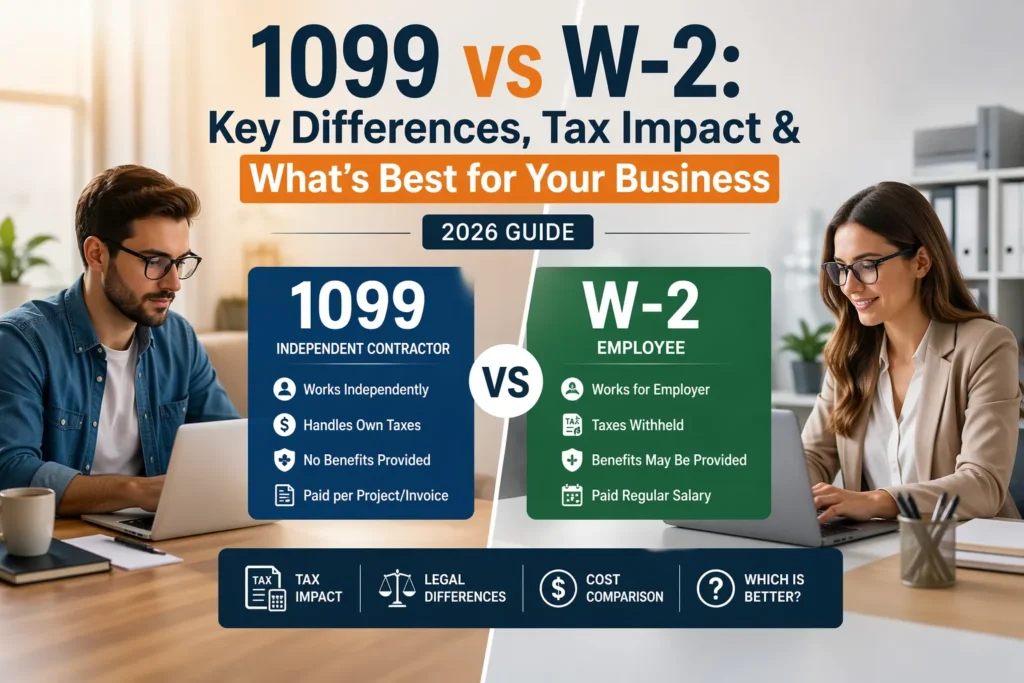
1099 vs w-2 is something that shows up in almost every serious conversation about hiring, taxes, or building a business team. And honestly, most confusion comes from one simple thing: people hear these terms but never get them explained in a real, practical way.
So here it is in a very straight, real-world way.
This is not just paperwork. This is how work actually runs in the background.
Let’s make 1099 vs w2 simple from the start
Think of it like this:
One side is someone working inside the system of a company.
The other side is someone working outside the system, but getting paid by it.
That’s really the heart of 1099 vs w2.
No complicated theory needed yet. Just understanding that one is employment, the other is independent work.
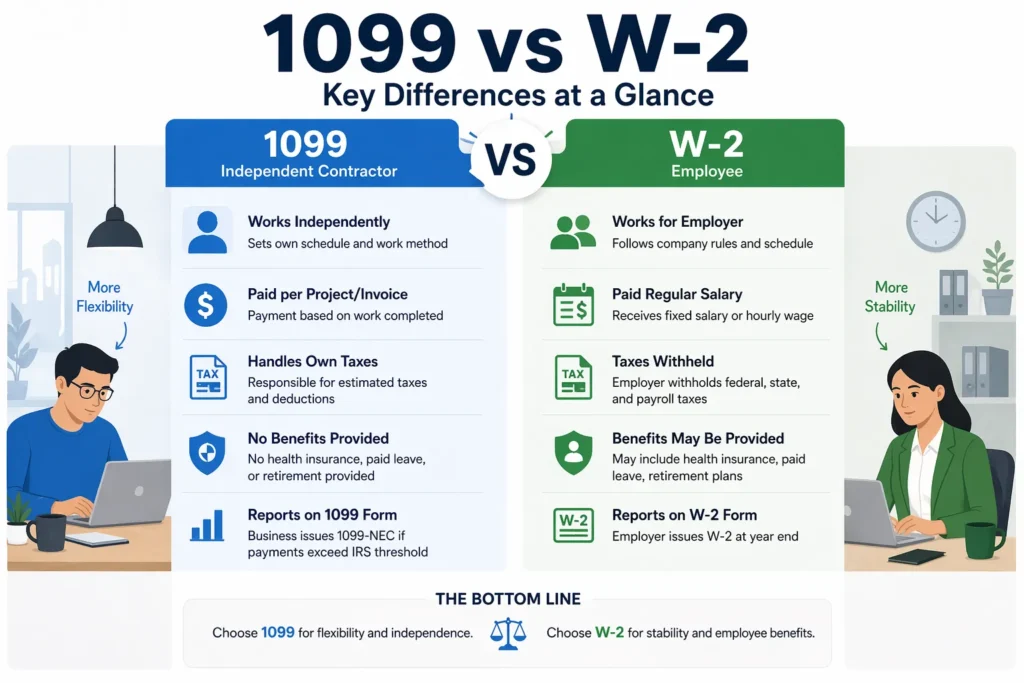
What a W2 employee really feels like in real life
A W2 employee is basically part of the company structure.
In day-to-day reality:
- Work comes from a manager or team lead
- Hours are set or expected
- Pay comes regularly like a salary
- Taxes are already handled before money arrives
- Sometimes benefits are included
So when someone asks what 1099 vs w-2 is, this side is the “stable job” side.
It feels predictable. You show up, you work, you get paid.
And the company carries most of the responsibility behind the scenes.
Now the other side: What a 1099 contractor actually is
A 1099 contractor works differently from the ground up.
There is no “employee relationship” in the traditional sense.
Instead:
- Work is agreed on as a project
- No fixed schedule from the company
- Payment is based on output or invoices
- Taxes are not deducted by the company
- Full independence in how work is done
So in 1099 vs w2, this side is the “own your work” model.
It feels more like running a small personal business, even if you’re working with clients.
The real difference people feel every day
When people compare 1099 vs w2, it’s not just legal definitions.
It shows up in daily life like this:
- One person waits for a paycheck automatically
- The other sends invoices to get paid
- One follows instructions
- The other decides how to complete the work
- One gets benefits included
- The other builds their own safety net
So the difference is not small. It changes how life is structured around work.
Taxes are where things become very real
This is where 1099 vs w2 becomes serious.
For W2:
- Taxes are cut before money reaches the employee
- No extra planning needed monthly
- End of year paperwork is simple
For 1099:
- Full payment comes first
- Taxes are handled personally
- Planning is required throughout the year
- Expenses and income need tracking
So one side is “automatic system,” the other is “self-managed system.”
That’s a big mental shift for many people.
What 1099 filing requirements actually mean in real talk
1099 filing requirements sound technical, but the idea is simple.
If a business pays a contractor enough money, it must officially report it.
So in practice:
- The business collects contractor details
- Payments are tracked during the year
- A tax form is issued at year end
- Everything is reported to tax authorities
In 1099 vs w-2, this is the compliance side most people ignore until it becomes a problem.
The rules behind 1099 workers
When people ask what are the rules for 1099 employees, it basically comes down to independence.
Here’s how it actually plays out:
- No one should control exact working hours
- No employee-style supervision
- No “clock in, clock out” structure
- Focus is on results, not time spent
So if a company starts controlling too much, it stops being a 1099 setup and starts looking like a W2 job.
That’s where 1099 vs w2 gets legally sensitive.
How 1099 work actually flows in real life
People often ask how does 1099 work, and the simplest breakdown is this:
- A job or project is agreed
- Work is delivered independently
- Invoice is sent
- Payment is made
- Contractor handles taxes later
No payroll system. No automatic deductions.
Just agreement, delivery, payment.
That’s the rhythm of 1099 vs w2 on the contractor side.
Why companies still choose W2 employees
Even with flexibility everywhere, companies still rely heavily on W2 employees.
Because:
- Work is more controlled
- Teams are easier to manage
- Long-term planning is more stable
- Training and processes stay consistent
So in 1099 vs w-2, W2 is about structure and predictability.
Companies like knowing exactly who is doing what every day.
Why 1099 contractors are becoming more common
On the other side, businesses also like contractors for a very simple reason: flexibility.
- They can scale up quickly
- They don’t need long-term commitments
- They can hire specialized talent fast
- Costs can be project-based
So 1099 vs w2 is also a flexibility vs stability decision.
The biggest mistake businesses make
One of the most common issues in 1099 vs w2 is misclassification.
This happens when:
- A contractor is treated like an employee
- Fixed schedules are enforced
- Full control is applied but no benefits are given
This can create serious tax and legal problems later.
So the classification is not just a label. It must match reality.
Cost difference in Real Terms
Let’s talk practical money thinking.
W2:
- Higher long-term cost for businesses
- Includes taxes, benefits, overhead
1099:
- No benefits cost
- No payroll tax handling
- Project-based payments
So 1099 vs w2 often comes down to budget structure.
Which One is Better? Honest Answer
There is no universal winner in 1099 vs w2.
It depends on the situation:
- Need stability → W2 works better
- Need flexibility → 1099 works better
- Need both → hybrid system works best
Most modern businesses actually use both together.
Conclusion:
If everything is stripped down:
1099 vs w2 is really just this:
- One is working for a company
- The other is working with a company
That small shift changes everything else:
taxes, control, freedom, responsibility, and income structure.
Frequently Asked Questions
What is the simplest way to understand 1099 vs w2 in daily life?
1099 vs w2 is basically the difference between having a regular job with taxes handled automatically and working independently where taxes and payments are managed personally.
Why do businesses prefer hiring 1099 contractors?
Businesses prefer contractors because it reduces long-term costs, increases flexibility, and allows hiring based on specific project needs instead of full-time commitments.
Can a person switch between 1099 and W2 work easily?
Yes, switching is possible, but it depends on how the job is structured. The role must change from independent work to employee-style work or vice versa.
Who is responsible for taxes in 1099 vs w2?
In W2, the employer handles tax deductions automatically. In 1099, the contractor is fully responsible for calculating and paying taxes.
What happens if classification is done incorrectly?
Incorrect classification can lead to tax penalties, legal issues, and back payments if workers are treated like contractors but function like employees.
Do 1099 contractors get paid more than W2 employees?
Sometimes yes, but not always. Contractors may earn more per project, but they do not receive benefits or paid leave like employees.
Why is 1099 filing important for companies?
It ensures that contractor payments are properly reported to tax authorities and keeps the business compliant with legal requirements.
Which is more stable 1099 vs w2?
W2 is generally more stable because income is regular and predictable, while 1099 income depends on available projects and client work.
Can someone have both 1099 and W2 income?
Yes, many people work a full-time W2 job while also doing freelance 1099 work on the side, as long as taxes are managed correctly.
What is the biggest takeaway from 1099 vs w2?
The biggest takeaway is that one model offers stability and structure, while the other offers independence and flexibility, and the right choice depends on the situation.