Salt deduction, let’s just start here. If you pay property taxes or state income taxes, this is one of the few tools that can actually lower your federal tax bill. Sounds good, right? But there’s a twist: the salt deduction cap. That’s the limit on how much you can claim, and it can change the math for a lot of people.
Here’s the deal: this affects real people every year, and understanding it can save you thousands.
What Is SALT Deduction, Really?
At its core, the salt deduction is a way to subtract taxes you’ve already paid to your state or local government from your federal taxable income. That usually means:
- Property taxes on your home
- State income taxes you’ve paid
- Sometimes state sales tax, if that’s the better option for you
Before 2018, there was basically no limit—you could deduct everything you paid. Then came the big beautiful bill salt deduction, and suddenly, there’s a ceiling. That’s the salt deduction cap.
The SALT Deduction Cap Made Simple
So, what is the salt cap exactly? Think of it like a speed limit on your deductions. No matter how much you paid in combined state and local taxes, only $10,000 per household counts for federal tax purposes. Filing separately? That drops to $5,000.
Here’s a quick snapshot:
| Filing Status | SALT Deduction Limit |
| Single / Married Filing Separately | $5,000 |
| Married Filing Jointly | $10,000 |
| Head of Household | $10,000 |
The key takeaway: anything above that number doesn’t give you extra tax relief. It’s just lost when it comes to federal taxes.
Why This Matters to Your Taxes
Imagine you paid $7,000 in state income tax and $5,000 in property taxes. That totals $12,000. With the salt deduction cap, only $10,000 actually lowers your taxable income. So, $2,000 doesn’t help you at all.
Basically, the cap says, “Yes, we’ll help, but only so much.” For people in high-tax states like New York or California, that can make a noticeable difference.
Tips to Make the Most of Your SALT Deduction
Even with the cap, there are ways to play it smart:
- Bunch your payments: Pay property taxes or state income taxes before year-end to maximize deductions for that year.
- Use sales tax deductions: If your state doesn’t have an income tax, this can sometimes be better.
- Look for exemptions or credits: Many states have property tax relief programs that reduce what you owe.
- Run the numbers with a SALT tax calculator: It’s the easiest way to see what actually counts.
How a SALT Tax Calculator Helps
A salt tax calculator is basically your best friend during tax season. You enter your numbers—state income tax, property taxes, maybe sales tax—and it tells you:
- How much of your payment counts
- Whether prepaying taxes helps
- How close you are to the $10,000 limit
Knowing this ahead of time can save surprises and stress when you file your federal return.
SALT Deductions Explained for Everyone
When people ask, “what is salt cap?” it’s just the maximum limit on state and local tax deduction—$10,000 for most households. Understanding this isn’t just about numbers—it’s about timing and strategy. How you pay, when you pay, and which taxes you claim can change the outcome by hundreds or even thousands of dollars.
The Big Beautiful Bill SALT Deduction
Here’s the backstory. The big beautiful bill salt deduction comes from the Tax Cuts and Jobs Act of 2017. It’s the law that put the cap in place. High-tax state residents felt it immediately because before, you could deduct way more.
So if you live in a high-tax state, plan ahead. The cap doesn’t care about how much you actually paid—it’s $10,000 and that’s it.
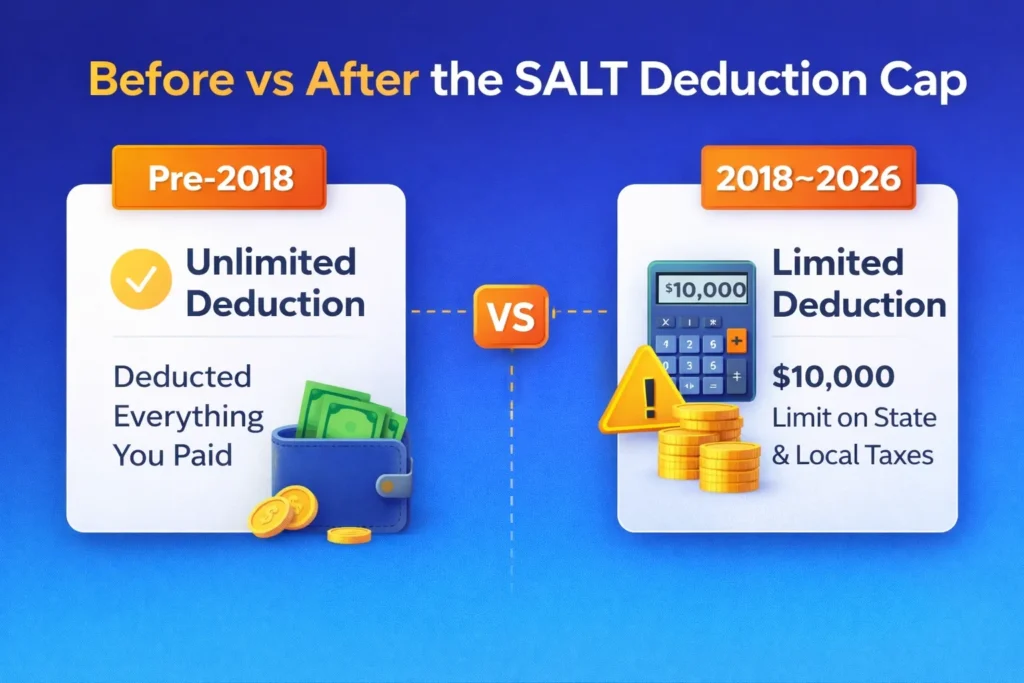
Quick Comparison: Before vs After the SALT Cap
| Year | Deduction Limit | What It Means |
| Pre-2018 | Unlimited | Deducted everything you paid |
| 2018–2025 | $10,000 | Cap introduced |
| 2026 | $10,000 | Cap remains, planning still crucial |
How to Track SALT Deductions Like a Pro
- Keep receipts for every property tax and state income tax payment
- Track sales taxes if you’re claiming them
- Use online salt tax calculators to run scenarios
- Time big payments wisely—bunch them at the end of the year if it helps
Conclusion:
The salt deduction is still a powerful way to lower your federal taxes. But understanding the salt deduction cap is key. Know what a salt cap, track your deductions for state and local taxes, and use tools like salt tax calculators. Plan ahead, stay organized, and don’t leave money on the table.
Frequently Asked Questions
What is the SALT deduction?
The SALT deduction lets you lower federal taxes by subtracting state and local taxes paid, including property, income, and sometimes sales taxes, from your taxable income.
What is the SALT deduction cap for 2026?
The cap is $10,000 per household for combined state and local taxes. Separate filers have a $5,000 limit.
Can I deduct my state sales tax instead of state income tax?
Yes. This is useful in states with no income tax. Choose the option that gives the bigger deduction.
How does the SALT deduction affect high-tax states?
High-tax state residents may hit the $10,000 cap quickly, which limits federal tax savings compared to previous years.
What is the difference between SALT and SALT cap?
SALT is the taxes you can deduct. SALT cap is the $10,000 limit on how much of those taxes you can actually claim.
How do I calculate my SALT deduction?
Add up state and local taxes, apply the $10,000 cap, and subtract from your federal taxable income. Online calculators make it easier.
Does the SALT cap apply to married filing separately?
Yes, the limit is $5,000 for separate filers and $10,000 for joint filers.
Can I carry over SALT deductions above the cap?
No, unused SALT deduction amounts cannot be carried to future tax years.
How can I maximize SALT deductions under the cap?
Prepay taxes, consider sales tax deductions, track credits or exemptions, and time payments smartly to optimize deductions.
Is the SALT deduction cap expected to change?
As of 2026, the cap is still $10,000. Future legislation could change it, but nothing is confirmed.