
How to pay yourself as a business owner is one of the first real questions that comes up when a business starts making money. At the start, it feels simple. Money comes in, so take some out. But doing that without a plan can quietly create problems.
This is not just about taking money. This is about doing it in a way that keeps the business stable, avoids tax issues, and builds something long term.
This guide walks through everything about business owner compensation. No complicated terms. Just what actually matters when figuring out how to pay yourself.
First, Understand What Paying Yourself Really Means
Before deciding how to pay yourself, understand one thing clearly.
The business and the owner are not the same when it comes to money.
Even if it feels like one pocket, it is not.
Taking money out needs structure. Without that, it becomes messy fast.
The Two Main Ways to Pay Yourself
There are only two main paths when thinking about how to pay myself:
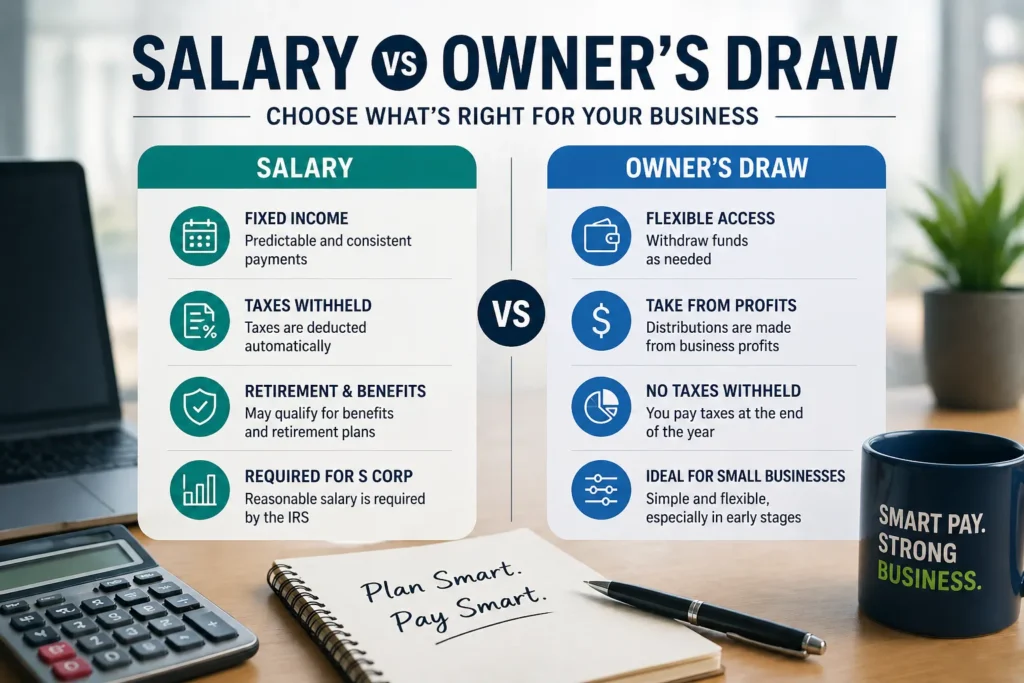
1. Owner’s Draw
Money is taken directly from profits.
- No fixed amount
- No strict schedule
- Flexible
2. Salary
A fixed payment like a job.
- Regular income
- Taxes deducted
- Structured
That is the core difference when people talk about owner’s draw vs salary.
What Is Owners Draw in Simple Words
To understand what is owners draw, think of it like this:
The business makes money. A portion of that is taken out for personal use. That is it. No paycheck. No formal payroll. Just taking from profit.
It works well when income is not stable.
How to Pay Yourself Based on Your Business Type
The answer to how to pay yourself changes depending on how the business is set up.
If Running a Sole Proprietor or Single LLC
- Use owner’s draw
- No salary needed
- Pay taxes on total profit
If Running a Partnership
- Use draw or agreed payments
- Split based on agreement
- Each partner handles taxes
Running an S Corporation
- Salary is required
- Extra profits can be taken as distribution
- Must follow S corp salary requirements
Running a C Corporation
- Paid through salary
- Dividends may be added
- More complex tax setup
Why S Corp Salary Rules Matter
When it comes to S corp salary requirements, there is no shortcut.
A reasonable salary must be paid first.
This means:
- It should match the work done
- It should match industry standards
- It should make sense based on revenue
Skipping this step can lead to penalties.
Understanding Owners Draw Taxes
Many get confused about how owners draw taxes.
It feels like no tax is taken when withdrawing money. But that does not mean tax is avoided.
Taxes are still paid.
What actually happens:
- Tax is based on total profit
- Not just what is withdrawn
- Self-employment tax applies
That is the real tax implications of the owner’s draw.
Simple Comparison Table
| Method | Fixed Income | Flexibility | Tax Handling |
| Owner’s Draw | No | High | Pay later on profits |
| Salary | Yes | Low | Taxes deducted upfront |
How to Pay Yourself Without Stressing the Business
One mistake happens often when figuring out how to pay yourself.
Taking money without a plan.
Better way:
- Decide a fixed amount
- Keep it consistent
- Adjust only when needed
This keeps both personal life and business stable.
How to Pay Yourself and Still Grow
Growth needs money.
Taking too much too early slows everything down.
So while deciding how business owner pay themselves, keep balance.
- Cover personal needs
- Leave room for growth
- Build reserves
This is how businesses last longer.
Paying Yourself as a Business Owner Smartly
Smart decisions around paying yourself as a business owner are simple.
Not fancy. Just disciplined.
- Start small
- Increase slowly
- Track everything
No guesswork.
Common Mistakes That Create Problems
A lot of stress around how to pay yourself comes from avoidable mistakes.
Watch out for these:
- Mixing personal and business money
- Ignoring taxes
- Taking random amounts
- Not tracking profits
Fixing these early saves a lot later.
A Simple Real Example
Let’s keep it real.
Example with Owner’s Draw
- Business earns 4000
- Take out 1500
- Rest stays in business
Example with Salary
- Fixed salary 2500
- Taxes deducted
- Remaining profit stays
Different method. Different impact.
How to Pay Yourself Consistently
Consistency solves half the problem of how to pay yourself.
Instead of guessing every month:
- Pick a date
- Pick an amount
- Stick to it
This builds discipline and clarity.
Conclusion:
At the end, how to pay yourself is not just about money.
It is about control.
Control over:
- Cash flow
- Taxes
- Growth
The right method depends on structure and goals. But the principle stays the same.
Take what makes sense. Leave what helps the business grow.
Frequently Asked Questions
What is the easiest way to start with how to pay yourself?
Start with an owner’s draw if the business is small or new. It gives flexibility and avoids complexity while still allowing money to be taken for personal needs in a controlled way.
How often should money be taken from the business?
A monthly or bi-weekly schedule works best. It keeps income predictable and helps manage expenses without putting sudden pressure on business cash flow.
Do taxes apply even if money is not withdrawn?
Yes, taxes are based on total profit, not just withdrawn amounts. Even if money stays in the business, it can still be taxable depending on the structure.
Is owner’s draw better than salary?
It depends on the business structure. Draw works well for flexibility, while salary is required in structured setups like S corporations where compliance matters more.
Can a business owner change how they pay themselves later?
Yes, as the business grows or structure changes, switching methods is common. Many move from draw to salary when scaling or changing tax elections.
What is the biggest risk in paying yourself incorrectly?
The biggest risk is tax issues and cash flow problems. Without planning, it can lead to penalties or running short of funds needed to operate the business.
Should all profits be taken out as income?
No, keeping some profit in the business helps growth, covers unexpected costs, and builds long-term stability rather than short-term gain.
Do LLC owners need to pay themselves a salary?
Not always. Most LLC owners use draws unless they elect S corporation status, where a salary becomes necessary for compliance.
How much should be taken from the business?
It should cover personal needs without hurting operations. A balanced approach ensures both personal stability and business growth remain intact.
Why is consistency important in paying yourself?
Consistency creates stability. It helps manage personal finances better and keeps the business running smoothly without sudden financial pressure.