
Working capital management is one of those things that quietly decides whether a business feels stable or constantly under pressure. It is simply about keeping enough money flowing inside the business so daily operations never stop. It becomes even more important in 2026 because costs move fast, payments get delayed, and cash does not always arrive when expected.
Working capital management is really about timing. Money coming in, money going out, and making sure there is no gap that creates stress.
Understanding Working Capital Management
Working capital management is basically the control of short-term money inside a business. It means checking how much cash is available, how much is owed by customers, and how much needs to be paid out soon.
It is what keeps a business running day to day without depending on emergency loans or last-minute fixes. It focuses on balance, not just profit.
In simple speaking terms:
- Money in hand
- Money coming in
- Money going out
It makes sure these three stay in sync.
The Working Capital Formula Made Easy
The working capital formula is straightforward and often used to check financial strength.
working capital formula = current assets minus current liabilities
Working capital management uses this formula like a quick health check. If the result is positive, the business is generally in a safe position. If it is negative, pressure starts building.
It is not just about calculating this number once, it is about watching it regularly and adjusting decisions based on it.
Why working capital management actually matters
Working capital management matters because it decides how smooth or stressful daily business life feels.
When capital management is done properly:
- Bills are paid on time
- Suppliers trust the business
- Employees are paid without delays
- Cash flow feels predictable
But when it is ignored:
- Payments get delayed
- Pressure builds up quickly
- Even profitable businesses struggle to survive
It is often the difference between growing steadily and constantly firefighting.
Working Capital Strategies that Actually Help
Working capital strategies are practical steps that improve cash movement instead of letting money sit stuck.
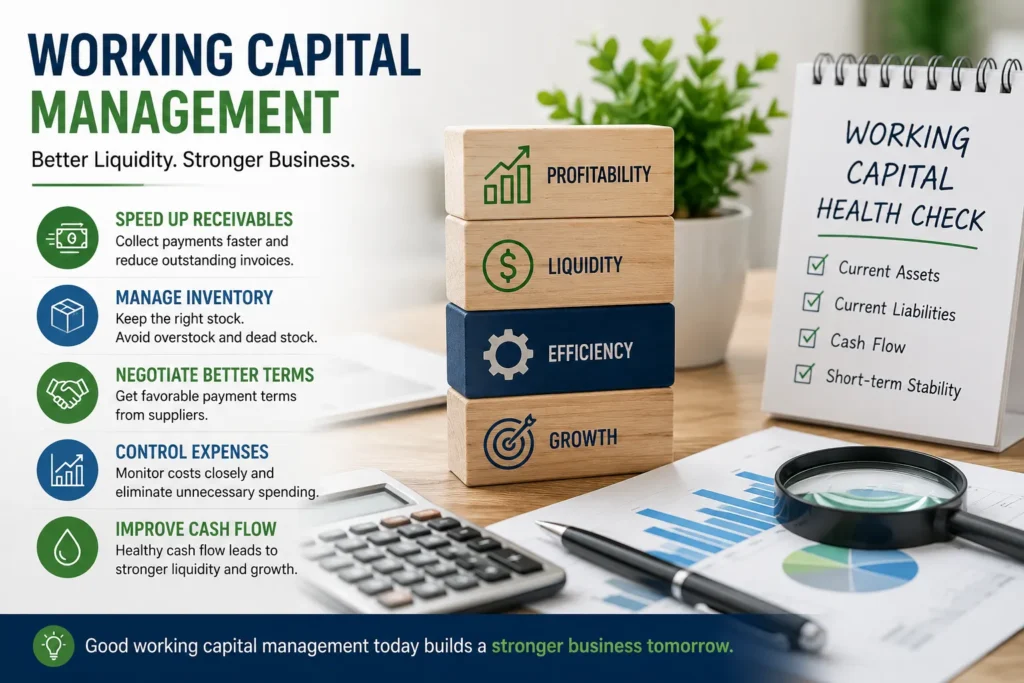
Some simple working capital strategies include:
- Collecting payments faster instead of waiting long cycles
- Reducing unnecessary stock that ties up cash
- Negotiating better payment terms with suppliers
- Keeping a close eye on daily expenses
- Avoiding slow or overdue customers
Working capital management improves naturally when these working capital strategies are followed consistently, not occasionally.
Liquidity Management and Cash Flow Management
Liquidity management is simply making sure there is always enough cash available for immediate needs. It is the “right now” view of money.
Cash flow management is the bigger picture. It tracks how money moves in and out over time and sits between both of them. It connects immediate cash availability with long-term flow patterns.
When liquidity management is weak, even small payments feel heavy. When cash flow management is weak, planning becomes guessing. Working capital management fixes both by creating balance.
How to Improve Working Capital Without Stress
To improve working capital, the focus is always on speed and control.
Simple ways to improve working capital:
- Get customer payments in faster
- Stop money from sitting in slow-moving inventory
- Send invoices immediately instead of delaying
- Follow up on unpaid bills regularly
- Cut unnecessary spending leaks
It improves when money stops getting stuck and starts moving at a healthy speed.
Working Capital Optimization in Daily Business
Working capital optimization is about using what already exists more efficiently instead of increasing costs.
This includes:
- Keeping inventory only when needed
- Avoiding over-ordering stock
- Using smarter payment schedules
- Tracking cash in real time
Working capital management becomes much stronger when working capital optimization is part of daily routine instead of a once-in-a-while activity.
Business liquidity and financial health
Business liquidity is about how quickly a business can turn its assets into cash to cover urgent needs. Business financial health is a wider view. It includes stability, profit, and long-term strength.
It directly affects both. If cash is stuck, liquidity becomes weak. If payments are controlled and assets move smoothly, financial health improves naturally.
Working capital for small businesses in real situations
Working capital for small businesses is even more critical because there is less room for error.
Small businesses often deal with:
- Delayed customer payments
- Limited cash reserves
- Sudden expenses
Working capital management helps small businesses stay steady even when income is uneven. It brings structure into unpredictable situations and reduces dependence on loans or emergency borrowing.
Simple table to understand flow better
| Area | What happens | Result |
| Cash coming in | Customer payments | Stability increases |
| Cash going out | Bills and expenses | Must be controlled |
| Inventory | Stock sitting idle | Cash gets stuck |
| Receivables | Pending payments | Delays hurt liquidity |
This simple flow is the core of capital management.
Conclusion:
Working capital management is not a complex financial concept when broken down. It is simply about keeping money moving in a controlled way so business operations never stop. Capital management builds confidence, reduces pressure, and makes financial planning easier.When working management is handled properly, the business stops reacting and starts planning ahead.
Frequently Asked Questions
What does working capital management actually mean?
Working capital management means making sure a business always has enough cash moving in and out at the right time so daily expenses, salaries, and bills are paid smoothly without financial stress building up.
Why do businesses struggle without working capital management?
Without working, money often gets stuck in unpaid invoices or unused inventory, which creates cash shortages even when sales are happening regularly in the business.
How does working capital management help in daily operations?
It helps by keeping enough liquidity available so suppliers are paid on time, employees are paid without delay, and operations continue without interruption or financial pressure.
What is the easiest way to improve working capital quickly?
The quickest way is to speed up customer payments, reduce slow-moving inventory, and control unnecessary expenses so cash starts flowing more freely in the business cycle.
How does working capital formula help in decision making?
The working capital formula helps by showing whether current assets are enough to cover short-term liabilities, giving a clear picture of financial stability at any moment.
What is the difference between liquidity management and cash flow management?
Liquidity management focuses on having cash available immediately, while cash flow management tracks how money moves over time, and both support.
Why is working capital important for small businesses specifically?
Small businesses rely heavily on working capital management because they usually have limited cash reserves and need careful control of money timing to avoid financial gaps.
What happens when working capital management is weak?
When capital management is weak, payments get delayed, suppliers lose trust, and even profitable businesses can face cash shortages that disrupt operations.
How does inventory affect working capital?
Excess inventory blocks cash inside unsold stock, which reduces available liquidity and weakens until that stock is sold or cleared.
Can working management improve business growth?
Yes, strong working capital management improves growth by keeping cash flowing smoothly, reducing financial stress, and allowing better planning for expansion and investment decisions.