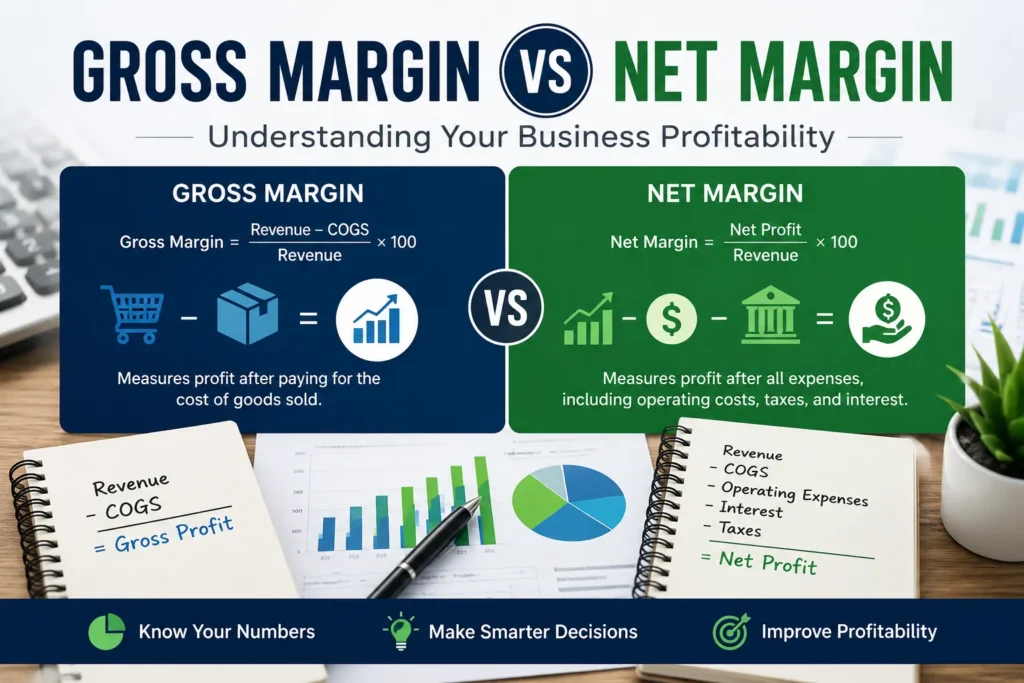
Gross margin vs net margin gives a business an understanding of how well it is converting sales into profit. Both of these measurements examine different aspects of profitability, so using both provides a more complete picture of financial performance.
Gross margin focuses on the revenue remaining after the direct costs of the goods and services produced are subtracted. Net margin extends to operating costs, interest, taxes and other expenses. They can be compared to determine if the problem with profits is due to production costs or total business costs.
What is Gross Profit Margin?
Gross profit margin indicates the proportion of profit that has been created by the company after deducting direct cost of goods or services sold. It basically is a measure of the profitability of the product or service itself, without taking into account any other expenses the business may have.
The gross profit definition is:
Gross Profit = Revenue − Cost of Goods Sold (COGS)
It is easier to understand the gross profit meaning when it is explained with the example. If a company earns $100,000 in revenue and has $60,000 in COGS, its gross profit is $40,000.
What is Net Profit Margin?
Net profit margin is a ratio of a company’s net profit to its total sales, revealing the extent to which the company is making a profit after accounting for all relevant expenses. These expenses can include salaries, rent, interest, taxes, and other business costs.
The net profit definition can be written as:
Net Profit = Revenue − Total Expenses
Net Profit Margin = (Net Profit ÷ Revenue) × 100
In other words, For example, if a business has $100,000 in revenue and $90,000 in total expenses, its net profit is $10,000 and its net profit margin is 10%.
What is the Difference Between Gross and Net Profit?
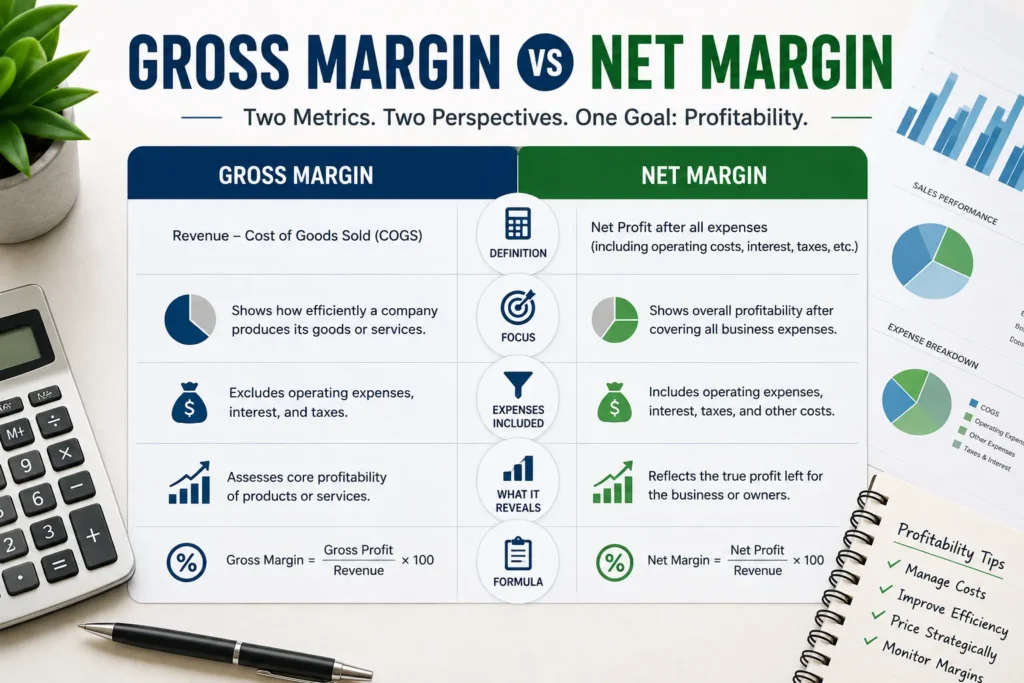
The key difference is the expenses included in each calculation. Gross profit vs net profit focuses on where costs are deducted.
| Gross Profit | Net Profit |
| Revenue minus COGS | Revenue minus all expenses |
| Measures core profitability | Measures overall profitability |
| Excludes many operating expenses | Includes operating and other expenses |
| Used to assess production efficiency | Used to assess total business performance |
Understanding gross vs net profit helps business owners identify whether costs are coming from producing products or from running the company overall.
How is Gross Profit Calculated?
To understand how to calculate gross profit, subtract COGS from total revenue.
Gross Profit = Revenue − COGS
The gross profit percentage equation is:
Gross Profit Margin = (Gross Profit ÷ Revenue) × 100
For example, revenue of $200,000 and COGS of $120,000 produce $80,000 in gross profit. The gross margin is therefore 40%.
How to Calculate Net Profit
Understanding how to calculate net profit means identifying all pertinent business expenses and deducting them from revenue. This can include payroll, operating costs, rent, utilities, insurance, interest and taxes.
A business can end up with a high gross margin but a low net margin due to high operating expenses. That is why both measures are appropriate in assessing profitability.
Why Does Gross Margin vs Net Margin Matter?
A combination of gross margin vs net margin can be used to show where a business is losing profitability. The shrinking gross margin could be due to escalating production cost or due to pricing issues, and a weak net margin could be due to high overhead or operating costs.
Monitoring both these margins over time will enable a business to make better pricing decisions, spending decisions, staffing decisions, and cost decisions.
How Can Businesses Improve Profit Margins?
Improving profitability usually requires examining both direct and indirect costs. Businesses may review supplier pricing, adjust product prices, reduce unnecessary expenses, improve operational efficiency, or focus on higher-margin products and services.
The right strategy depends on why the margin is low rather than simply trying to cut every expense.
Conclusion
Gross margin vs net margin provides two different views of business profitability. Gross margin shows how much revenue remains after deducting the direct costs of producing goods or delivering services, while net margin shows how much profit remains after deducting all applicable business expenses.
A knowledge of gross profit margin, net profit margin, and how to calculate the balance of the two will ease the interpretation of financial statements and assist businesses in finding ways to become more profitable.
Frequently Asked Questions
What is the difference between gross margin vs net margin?
The difference between gross margin vs net margin is the expenses included. Gross margin includes the revenue that will be available after COGS, and net margin includes the profit after operating and other relevant business costs.
What is a gross profit margin?
Gross profit margin is a percentage (profit margin) that is calculated by taking revenue minus the cost of goods or services sold. It assists in comparing the profitability of a company’s main products/services.
How is gross profit calculated?
Gross profit = Total revenue – COGS. For example, $100,000 in sales minus $60,000 in COGS results in $40,000 of gross profit.
How do you calculate gross profit?
To understand how to calculate gross profit, use the formula Revenue − Cost of Goods Sold. The amount is what’s left after the direct costs of producing goods or delivering services have been subtracted.
What is the gross profit percentage equation?
Gross Profit Percentage Equation: Gross Profit/Revenue x 100. It translates gross profit as a percentage for easy comparison of profitability from one period or one business to another.
What is the gross profit definition?
Under the gross profit definition, a business’s gross profit is the revenue earned from selling goods and services minus the cost of goods sold.
How do you calculate net profit?
How to calculate net profit involves subtracting total business expenses from total revenue. The calculation should account for the expenses applicable to the company’s accounting period and financial structure.