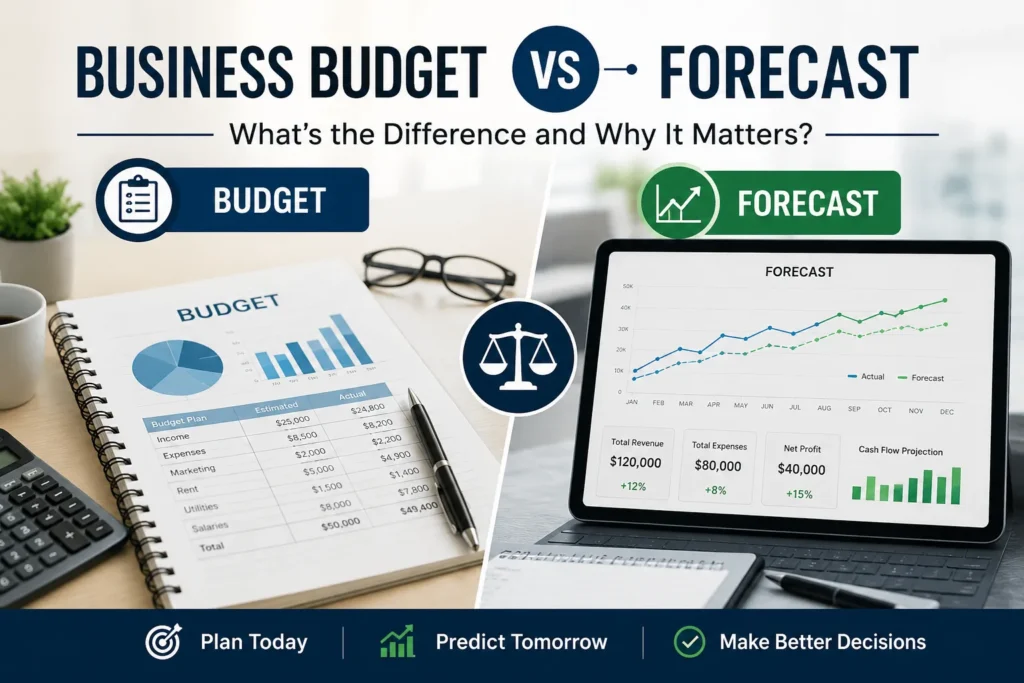
Budgeting and forecasting is something every business owner hears about, but most people do not fully understand how practical it really is until they start managing real money, real expenses, and real pressure in their business.
Let’s break down business financial planning solutions and the difference between budgeting and forecasting.
What is Actually Happening When We Talk About Financial Planning
In real business life, business forecasting is not just a finance department task. It is basically how a business decides where money should go and what kind of income it expects in the future..
Budgeting and forecasting gives you that structure so you are not just reacting to problems but actually planning ahead for them.
Most businesses are usually just not tracking or adjusting their financial direction properly.
The Simple Difference Between Budget and Forecast
This is where most confusion happens.
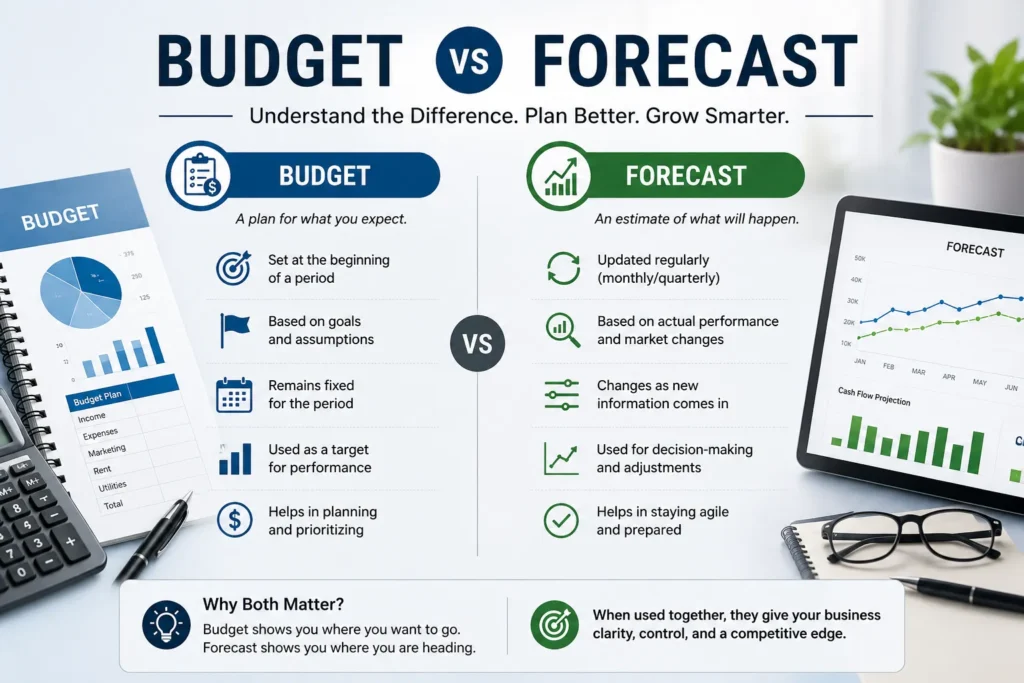
- A budget is what you plan at the start. It is your target.
- A forecast is what you adjust along the way. It is your reality check.
Budgeting and forecasting shows the destination and the other keeps correcting your route based on traffic, delays, or shortcuts. Because business does not stay the same for 12 months.
Why Businesses Cannot Ignore this Anymore
In today’s environment, things change too fast. Costs go up, demand shifts, and competition moves quickly.
Without budgeting and forecasting, businesses are basically making decisions blind.
Here is what it actually helps with:
- You stop overspending without realizing it
- You understand where profit is really coming from
- You catch problems before they become serious
- You make hiring and investment decisions with more confidence
- You reduce financial stress because numbers are clearer
Budgeting and forecasting is not about perfection. It is about control and awareness.
How Revenue Expectations Actually Get Built
Revenue forecasting is not just a random number you hope for. It is built using data, trends, and actual performance patterns.
When businesses do proper financial forecasting, they look at past sales, current pipeline, seasonality, and market conditions.
This is where budgeting and forecasting becomes powerful because it connects expectations with reality.
If you are only guessing revenue, your whole plan becomes weak from the start.
How Business Planning Actually Works in Real Companies
In real operations, business owners and finance teams usually follow a cycle like this:
- Set initial financial plan
- Track actual performance every month
- Compare results with expectations
- Adjust projections when things change
- Update decisions based on new numbers
This ongoing loop is where budgeting and forecasting becomes practical instead of theoretical.
It is not a one time exercise. It is a system that keeps repeating.
Why Most Small Businesses Struggle with Money Planning
The biggest issue is not lack of effort. It is a lack of structure.
Many small businesses:
- Do not update their numbers regularly
- Rely on memory instead of data
- Do not track expenses properly
- Overestimate income potential
- Ignore slow changes in the market
Budgeting and forecasting solves this by forcing a discipline of regular review.
Once you start looking at numbers consistently, decisions become much clearer.
The Emotional Side of Financial Decisions
This part is often ignored. Business owners do not always make decisions logically. That is why budgeting and forecasting is so important. It removes emotional guessing and replaces it with structured thinking. Instead of asking can I afford this, you start asking what the numbers actually say.
That shift alone can change how a business operates.
Tools People Actually Use in Real Life
You do not need complicated systems at the beginning. Most businesses start simple and then scale up.
Common tools include:
- Basic spreadsheets for tracking
- Accounting software for transactions
- Dashboards for monthly reporting
- Simple financial models for planning
Budgeting and forecasting becomes more accurate when data is updated regularly.
Even simple tools can work well if they are used consistently.
Common Mistakes that Cause Financial Confusion
A lot of problems come from small mistakes repeated over time:
- Treating budget as fixed and never updating it
- Ignoring small cost increases
- Not reviewing financial data monthly
- Mixing personal and business expenses
- Overplanning revenue without proof
When these issues build up, businesses start feeling like money is always tight even when revenue looks fine on paper.
Simple Comparison to Understand It Better
Budget side:
- Set once a year
- Based on expectations
- Used as a target
- Does not change often
Forecast side:
- Updated regularly
- Based on actual performance
- Used for decisions
- Changes with business conditions
When both work together, budgeting and forecasting creates a complete financial picture instead of a static plan.
Why This Actually Improves Business Growth
Once a business gets consistent with financial tracking, growth becomes more predictable.
Here is what improves over time:
- Better control over cash flow
- Faster decision making
- Less financial uncertainty
- More accurate planning for expansion
- Stronger confidence in investments
Budgeting and forecasting helps shift a business from reactive mode to planned growth mode.
Real situation example
Imagine a business expecting steady monthly income throughout the year.
After a few months, they notice sales are increasing in some areas but slowing in others. Costs are also slightly higher than expected.
Without adjustment, they might continue using outdated assumptions.
But with proper budgeting and forecasting, they can realign strategy before problems grow.
That is the real value. It is not just numbers. It is timing and awareness.
Conclusion:
At the end of the day, budgeting and forecasting is not something only big companies use. It is something every business needs if it wants stability and clarity.
It helps connect planning with reality and removes a lot of guesswork from decision making.
When used properly, it becomes less about finance and more about running a smarter, more controlled business.
Frequently Asked Questions
Why do businesses struggle without proper financial planning?
Because they often make decisions based on guesswork instead of actual data, which leads to cash flow issues and missed opportunities.
Is budgeting only useful for big companies?
No, even small businesses benefit from it because it helps them understand where money is going and what they can realistically afford.
How often should financial planning and forecasting be reviewed?
Ideally every month, because business conditions change too quickly to rely on yearly assumptions alone.
What happens if forecasts are wrong?
That is normal. The purpose is not perfect accuracy but continuous adjustment so decisions stay relevant.
Can a business survive without structured planning?
Yes, but it usually operates with higher risk, more uncertainty, and less control over financial outcomes.
What is the biggest mistake business owners make?
They create a plan once and never update it, which leads to outdated decisions and financial confusion.
How does revenue prediction help in real life?
It helps businesses plan hiring, expenses, and investments based on expected income instead of assumptions.
Why is tracking expenses so important?
Because small unnoticed costs can slowly reduce profit margins without being obvious at first.
Do tools matter or is it just about discipline?
Both matter, but discipline is more important because even simple tools work if used consistently.
What is the main takeaway from all of this?
That financial clarity comes from regular review and adjustment, not from one time planning.