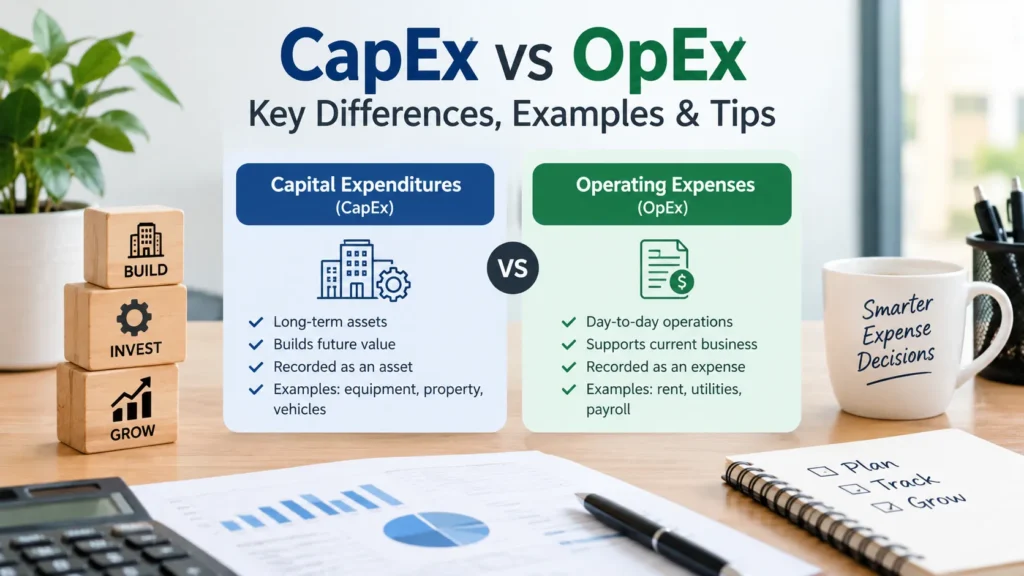
Understanding capital expenditures vs operating expenses is important for managing a business’s finances. They both come with a price tag, but have different objectives and are different items on the accounting books.
Simply put, capital expenditures tend to be funds used to purchase assets that provide benefits to a business for a longer duration, whereas operating expenses are the regular expenses associated with the running of a business.
What Are Capital Expenditures?
Capital expenditures are expenditures that are made in order to acquire, improve, or maintain long-term assets. These are the assets that are expected to benefit the business in the future for a period longer than the accounting period they are in.
Some typical capital expenditure examples are the purchase of property, equipment or machinery, vehicles, and major improvements on a building.
In general, the changes in such transactions are reported on the balance sheet as assets and not as a 100% expense upon acquisition.
What Are Operating Expenses?
Operating expenses (OpEx) are the ongoing expenses associated with the day-to-day operations of a business. They are usually eaten on an ordinary course of business and are debited when they are used in the period of the business transactions to which they apply.
Examples of common operating examples include: rent, utilities, office supplies, advertising, employee wages, insurance, routine maintenance.
These costs are the costs required to operate the business day to day.
CapEx vs OpEx: The Main Difference
The easiest way to grasp the difference between CapEx vs OpEx is to simply ask why they are spending the money.
Typically, CapEx involves the acquisition of a long-lived asset. Typically, OpEx includes the costs involved in running the business on an ongoing basis.
For instance, a delivery vehicle may be a capital expense, while fuel, insurance and maintenance of the vehicle may be operating expenses.
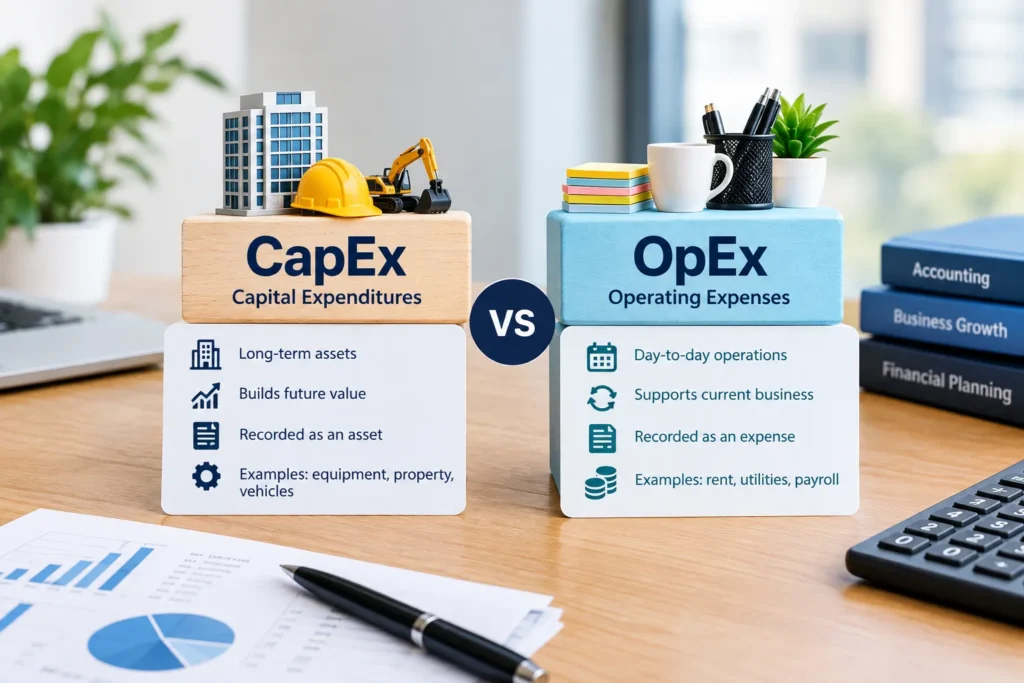
| Capital Expenditures (CapEx) | Operating Expenses (OpEx) |
| Usually related to long-term assets | Usually related to daily operations |
| Provides benefits over multiple periods | Usually supports current operations |
| Recorded as an asset initially | Generally recorded as an expense |
| Examples: equipment, buildings, vehicles | Examples: rent, utilities, payroll |
Capital Expenses vs Operating Expenses in a Small Business
The difference between capital expenses vs operating expenses can be especially important for small businesses. It’s important for owners to understand that it’s a long term investment or simply a cost to keep the business running.
For instance, a new computer system for a few years of use could be viewed differently than a monthly software subscription. Knowing the distinction is important for budgeting, financial reporting and tax planning.
Business Capital Expenditures
Business capital expenditures can include the purchase of property, the acquisition of equipment, investments in technology infrastructure, the purchase of vehicles, and major improvements. These investments can enable a company to grow its capacity, increase its productivity or provide for future expansion.
Since CapEx can be quite expensive, businesses tend to budget for these purchases in advance, instead of treating them as a regular monthly expense.
Business Operating Expenses
Business operating expenses is the regular and continuous cost of running a business. They can be employee pay, rent, utilities, marketing, professional services, insurance, etc. and office expenses.
Knowing these costs can assist business owners make major investments or financing decisions based on the amount of resources it requires to operate the business.
Fixed Assets and Operating Costs
The distinction between fixed assets and operating costs is another useful way to understand capital expenditures vs operating expenses. An asset that is long-term in nature, like a building, a machine, furniture and a car.
On the other hand, expenses that are incurred in the normal course of business are called operating costs. A company can have a piece of equipment as a fixed asset and also incur operating expenses for its use, like electricity, maintenance and supplies.
Expense Classification for Small Business
Accurate expense classification for small businesses helps keep financial records organized. Incorporating major asset purchases into ordinary expenses or routine expenses into capital assets will impact financial statements and tax reporting.
Treatment may vary based on the accounting requirements, type and price of the purchase, and tax laws. If the classification is in question, a qualified accountant can be consulted to decide on the correct classification.
CapEx and OpEx Accounting
CapEx and OpEx accounting involves recording these two types of spending differently. Capital purchases are usually capitalized as assets, and then depreciated or amortized if the asset has a useful life.
Usually expenses are recognized in the period they are incurred. The accounting treatment of the cost may differ depending on the accounting framework and the type of cost.
Conclusion:
The principle of capital expenditures vs operating expenses is understanding the difference between investing in long-term business assets and spending for business operations.
Capital Expenditure is normally linked to assets that produce benefits over time and operational expenditure is the cost of running the business. Separate classification of the two can facilitate better budgeting, reporting, and financial planning.
Frequently Asked Questions
What is the difference between capital expenditures vs operating expenses?
Typically, CapEx is spending money to acquire or enhance long-term assets, whereas OpEx is the cost of running the business.
What are examples of capital expenditures?
Buildings, vehicles, machines or equipment, major equipment, and significant improvements to property are examples of items.
What are examples of operating expenses?
These can include rent, salaries, utilities, insurance, advertising, office supplies and routine maintenance.
Is buying equipment capital expenditures vs operating expenses?
Generally, equipment is classified as CapEx if it is a long-term asset that will benefit the company for more than one accounting period.
Is maintenance a capital expenditure?
Routine maintenance is generally an operating expense. Major improvements that extend an asset’s useful life or significantly increase its value may receive different treatment.
Why is expense classification important for small businesses?
Proper classification helps businesses maintain accurate financial statements, track spending, prepare budgets, and apply appropriate accounting and tax treatment.
Are salaries CapEx or OpEx?
Employee salaries are generally operating expenses because they are part of the ongoing cost of running the business.
How are CapEx purchases recorded?
Capital purchases are generally recorded as assets and may be depreciated or amortized over their useful lives, depending on the applicable accounting rules.
How are operating expenses recorded?
Operating expenses are generally recognized as expenses during the accounting period in which they are incurred.
Can the same purchase have different accounting treatment?
Yes. Treatment can depend on the nature of the purchase, its cost, useful life, applicable accounting standards, and tax rules. When unsure, consult an accounting professional.