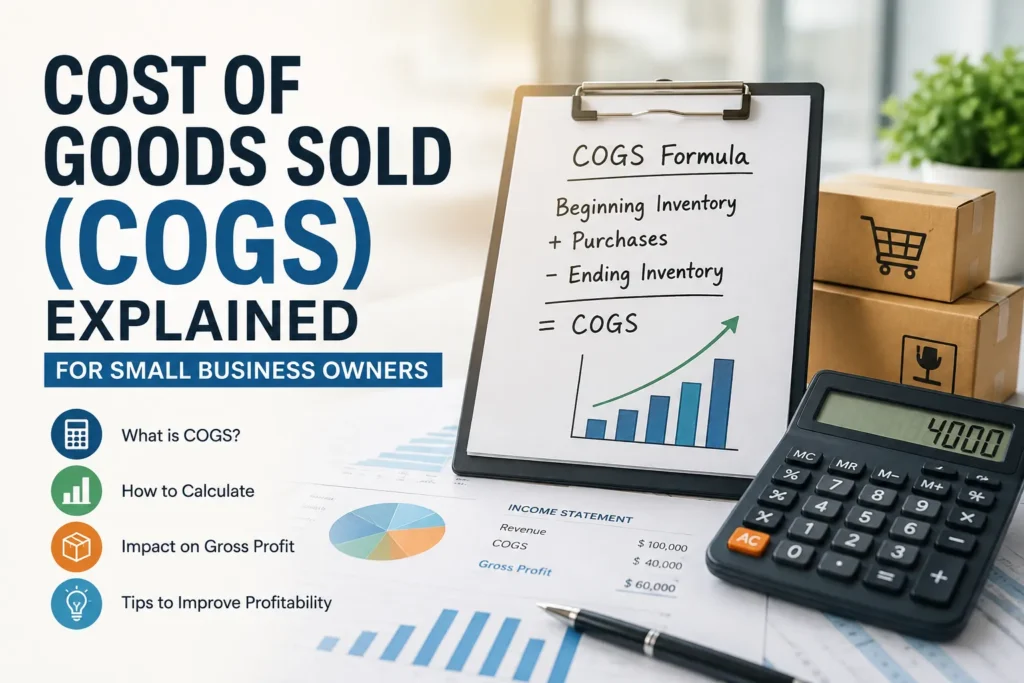
Here is the thing about running a business. You ring up a sale. Money comes in. You feel good. But that number does not tell you anything about whether you are actually making money. Not until you subtract what it cost to make or buy what you sold.
That is where the cost of goods sold comes in.
What is Cost of Goods Sold
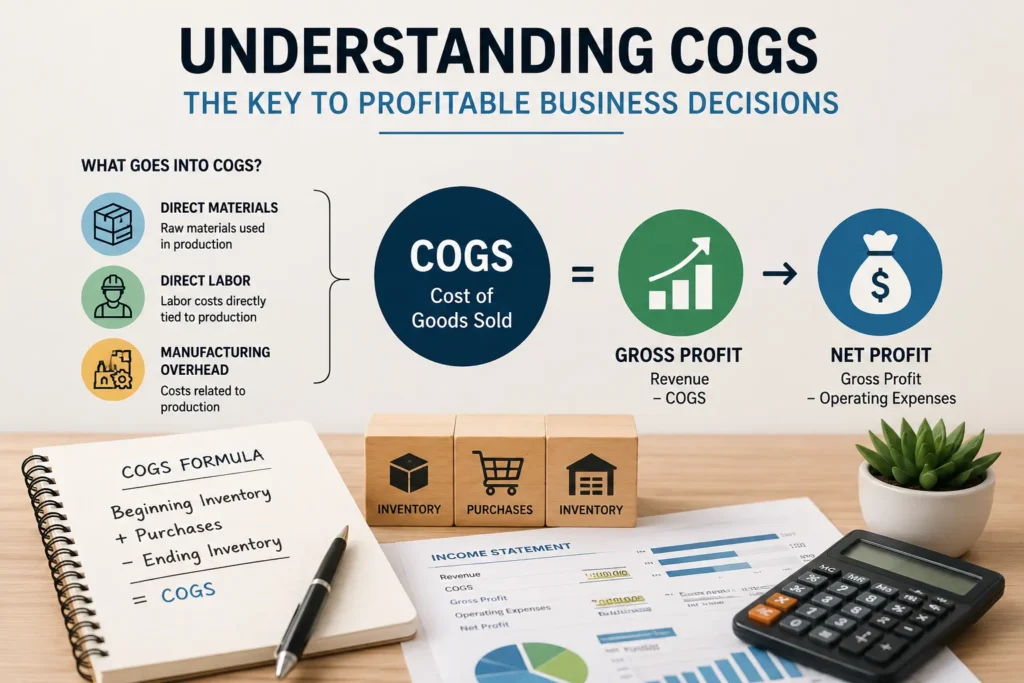
Cost of goods sold is the direct cost of producing or purchasing the products your business sells. It includes materials, labour directly tied to production, and shipping costs to get the product to your customer.
It is the cost you incurred to create the product, not the cost of selling it. That is a different line item called operating expenses.
What is cogs in accounting is a common question. In accounting, COGS is an expense reported on your income statement. It is subtracted from your total revenue to find your gross profit .
How to Calculate COGS
The COGS formula is straightforward. You start with your beginning inventory, add purchases made during the year, and subtract your ending inventory.
COGS = Beginning Inventory + Purchases − Ending Inventory
That is the most common method. It is also the simplest.
Here is a cost of goods sold calculation in action. Suppose your beginning inventory is $30,000. You buy $20,000 worth of products during the year. Your ending inventory is $10,000. Your COGS is $30,000 plus $20,000 minus $10,000, which gives you $40,000.
If you are a manufacturer, the calculation includes raw materials, labour costs, and factory overhead.
COGS vs Operating Expenses
This is the distinction that confuses most business owners.
Cost of goods sold includes costs directly tied to the production of goods. For a bakery, that is flour, butter, sugar, and the baker’s wages. For a clothing store, it is the wholesale cost of the clothes and shipping.
Operating expenses are the costs of running your business, not making your products. Rent, marketing, administrative salaries, utilities, software subscriptions, and office supplies are operating expenses.
COGS is subtracted from revenue to calculate gross profit. Operating expenses are subtracted from gross profit to calculate operating profit. You need both numbers to understand your business.
COGS on Income Statement
COGS on income statement appears right under revenue. It is the first expense deducted. It is used to determine gross profit and, later, net income. This calculation helps you understand how efficiently your business is producing goods or purchasing them from suppliers.
Gross profit is your revenue minus COGS. If your COGS is high relative to revenue, your margins are tight. If it is low, your margins are healthy. Understanding this relationship is essential for pricing, budgeting, and profitability.
COGS and Gross Profit
COGS and gross profit are directly connected. As your COGS rises, your gross profit declines. As your COGS falls, your gross profit increases. Gross profit is one of the most important metrics for a business because it tells you whether you are pricing your products correctly. It also provides useful information for budgeting, forecasting, and making strategic profitability decisions.
For example, if you sell a product for $100 and it costs you $60 to make or buy, your gross profit is $40. If your COGS increases to $70, your gross profit drops to $30. That affects your ability to cover operating expenses and generate net profit.
How Inventory Tracking Impacts COGS
Inventory valuation matters. Your cost of goods sold depends on how you value your inventory and which goods you are selling first.
- FIFO (First In, First Out). Assumes the oldest inventory is sold first. In periods of rising prices, FIFO results in a lower COGS and higher gross profit.
- LIFO (Last In, First Out). Assumes the newest inventory is sold first. In periods of rising prices, LIFO results in a higher COGS and lower gross profit . LIFO is allowed in the US but is banned under IFRS, the international standard.
- Average Cost Method. Average cost across all units in inventory. Simple and consistent. It smooths out price fluctuations and offers a middle ground between FIFO and LIFO.
How to Lower COGS Without Reducing Quality
- Negotiate with suppliers. Volume discounts, bulk orders, and long-term contracts can reduce the per-unit cost of inventory.
- Review production processes. Reducing waste, improving worker efficiency, or simplifying packaging can lower your COGS.
- Outsource non-core production. If a component is cheaper to outsource, it may be worth the trade-off.
- Use inventory tracking software. Software reduces waste, prevents stockouts, and helps you avoid holding slow-moving products.
How to Use COGS to Make Better Decisions
Set smarter pricing. If your COGS is creeping up, you might need to adjust your prices or change suppliers.
Monitor margins. Gross profit margin is your COGS divided by revenue. Track it monthly. If it is shrinking, investigate why. Accurate bookkeeping helps you maintain reliable financial records and identify changes in margins over time.
Manage inventory. The longer stock sits, the more it costs you. Holding costs, storage fees, and obsolescence all drive up your COGS.
Conclusion
Cost of goods sold is one of the most important numbers in your business. It directly affects your gross profit, your pricing strategy, and your overall profitability. Understanding how to calculate it, how to track it, and how to use it to make better decisions will help you run a stronger, more profitable business.
Frequently Asked Questions
What is cost of goods sold?
It’s the direct cost of making or buying what you sell — materials, labor, shipping. It does not include rent, marketing, or admin stuff.
What is the COGS formula?
Beginning inventory plus purchases minus ending inventory. That’s the standard formula. If you manufacture, you also add raw materials, labor, and overhead.
What is the difference between COGS and operating expenses?
COGS is what it costs to make or buy your product. Operating expenses are what it costs to run your business — rent, salaries, marketing. They’re not the same.
Where does COGS appear on the income statement?
It’s the first expense you’ll see, right after revenue. Subtract it from revenue and you get gross profit.
What is the difference between COGS and gross profit?
Gross profit is revenue minus COGS. It shows what you’re making before operating expenses hit. COGS is just the direct cost of your product.
How do I lower my COGS?
Negotiate with suppliers. Review your production process. Outsource non-core production. Use inventory software to cut waste.
How often should I calculate COGS?
Monthly is ideal. It helps you spot trends early and adjust pricing, suppliers, or production before problems get serious.
Why is tracking inventory important for COGS?
How you value inventory affects your COGS and gross profit. Common methods are FIFO, LIFO, and average cost. Each one changes your numbers.
Can COGS be negative?
No. COGS is always a positive number. It represents real costs you actually paid.