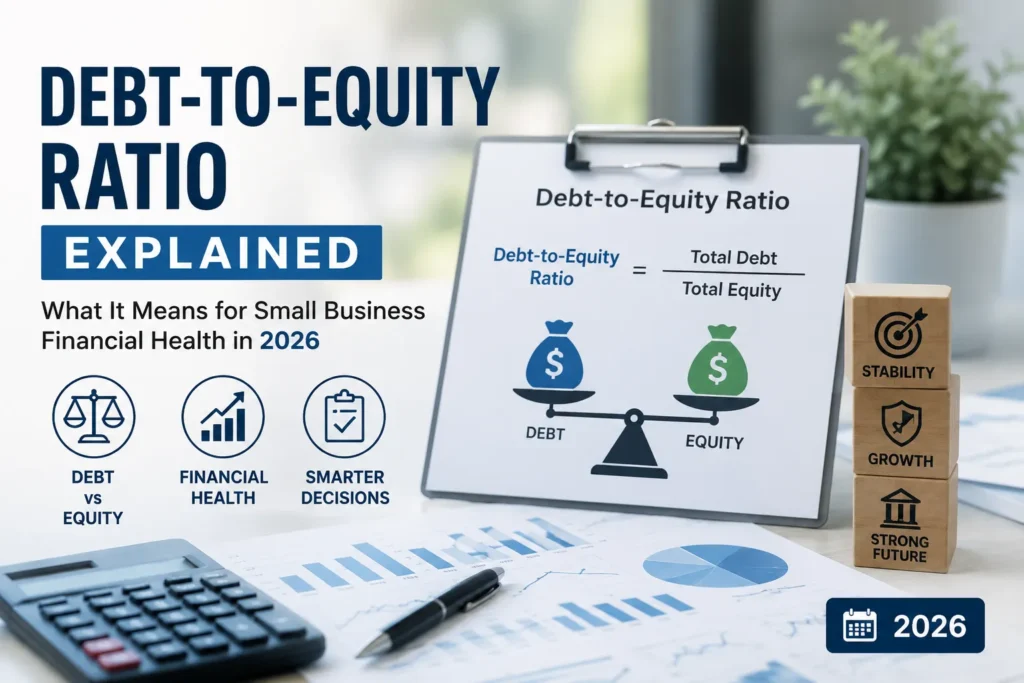
Debt to equity ratio is one of those financial signals that quietly tells the real condition of a business without any decoration. It is about how the business is actually holding itself together underneath.
It shows how much of the business is running on borrowed money and how much is built on its own strength.
And in 2026, this matters even more because financial pressure is real, funding is more selective, and business financial health is being judged with much sharper attention.
So this is practical survival knowledge for any business owner.
What Debt-to-Equity Ratio Really Means?
Debt to equity ratio is basically a reflection of how the business is built.
Think of it like this:
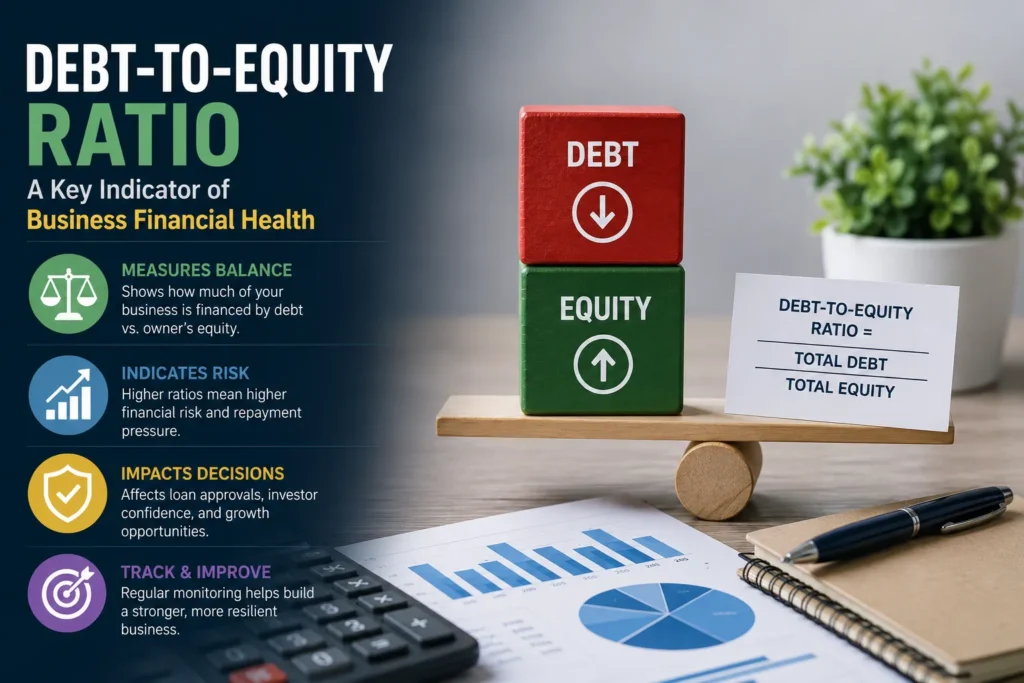
- Debt is money that must be paid back
- Equity is money that belongs to the business owner
So when the ratio increases, it simply means the business is leaning more on borrowed support.
When it decreases, it means the business is standing more on its own foundation.
This is why it sits at the center of balance sheet analysis, because it shows structure, not just performance.
Why This Ratio Feels So Important in 2026
In 2026, business decisions are more sensitive.
Loans are not as easy as before. Interest costs matter more. Cash flow mistakes are harder to recover from.
So business financial health is no longer judged by growth alone.
It is judged by:
- how stable the business is under pressure
- how easily it can survive slow revenue months
- how much control it has over repayments
And that is exactly where equity ratio becomes a real decision-making signal.
It tells whether growth is healthy or forced.
How Debt to Equity Ratio is Calculated
Understanding how to calculate equity ratio is actually very simple when explained properly.
Debt to Equity Ratio Formula:
Total Debt ÷ Total Equity
That’s the entire formula.
No complexity, no hidden steps.
Real example:
- Business debt: 250,000
- Business equity: 125,000
So:
250,000 ÷ 125,000 = 2.0
That means the business is operating with twice as much borrowed money compared to owner investment.
And that immediately signals higher financial pressure.
What is a Good Debt-to-Equity Ratio in Real Business Terms?
The question what is a good debt to equity ratio does not have a single fixed answer.
Because different businesses operate differently.
But in real speaking terms:
- Low range (0.5) → business feels light, stable, and safe
- Balanced range (1.0) → healthy mix of debt and ownership
- Higher range (1.5 to 2.0) → growth is happening but pressure is visible
- Very high (2.5+) → business is heavily dependent on debt
So a “good” debt to equity ratio is not just about being low.
It is about being stable enough to handle real-world pressure.
What This Ratio is Really Saying About Business Financial Health
When people talk about business financial health, they often think about profit.
But this ratio tells something deeper.
It tells:
- how the business survives when income slows down
- how much pressure is sitting behind the scenes
- how dependent growth is on borrowed money
A strong debt to equity ratio usually means the business has breathing space.
A weak one means the business is constantly balancing repayment pressure.
Balance Sheet Analysis in Real Understanding
In real balance sheet analysis, this ratio is one of the fastest reality checks.
Because it answers a simple question instantly:
Is the business growing on strength or growing on pressure?
Over time:
- If the debt to equity ratio keeps rising → risk is building quietly
- If it stays controlled → business is financially balanced
- If it drops → ownership strength is improving
Trends matter more than single numbers.
Financial Leverage and What It Feels Like in Business
The financial leverage ratio is closely connected to this.
And in real speaking terms, leverage is just “how much borrowed power is being used to grow.”
It feels like this:
- High leverage → faster growth but tighter financial control
- Low leverage → slower growth but more freedom and safety
So when equity ratio increases, leverage increases too, and the business becomes more sensitive to financial changes.
Debt to Net Worth Ratio Connection
The debt to net worth ratio works like a second lens.
It looks at:
- Total debt
- Total net worth
When used together with debt to equity ratio, it gives a clearer understanding of:
- True ownership strength
- Hidden financial exposure
- Overall stability of the business
This is why professionals rarely rely on just one ratio.
How to Read Debt to Equity Ratio Like a Business Owner
Instead of thinking of debt to equity ratio as a technical number, it helps to read it like a message.
It is basically saying:
- Low ratio → “business is in control”
- Medium ratio → “business is growing carefully”
- High ratio → “business is under financial weight”
So the real focus should be:
Is the business growing comfortably or growing under pressure?
Simple Table to Understand Real Impact
| Level | What It Feels Like | Business Reality |
| Low | Calm operations | Strong stability |
| Medium | Controlled growth | Balanced structure |
| High | Financial pressure | Debt-heavy growth |
This is how equity ratio shows up in real business life, not just accounting sheets.
Conclusion:
The debt to equity ratio is not just a number for accountants. It is a real signal of how a business is built, how it grows, and how it survives under pressure.
In 2026, where financial stability matters as much as growth, understanding this ratio helps avoid silent risks and makes decision-making much clearer.
Because profit shows success.
But structure shows survival.
And this ratio shows both.
Frequently Asked Questions
What is the debt to equity ratio?
It is a comparison that shows how much of a business is funded by loans compared to how much is funded by the owner’s own money, giving a clear view of financial balance and risk.
Why is equity ratio important for business financial health?
Because it shows whether the business is stable or over-dependent on borrowed money, which directly affects long-term survival, stress levels, and growth flexibility.
How do you calculate equity ratio easily?
It is calculated by dividing total debt by total equity, which shows how much debt supports each unit of ownership in the business.
What is considered a safe equity ratio?
Generally, 0.5 to 1.5 is considered stable, but the right level depends on industry type, cash flow strength, and how the business operates.
Can a high equity ratio still work?
Yes, it can work if cash flow is strong, but it increases financial pressure and reduces flexibility during slow business periods.
How does this ratio affect lenders?
Lenders use it to measure risk. A balanced ratio improves trust and increases chances of approval and better loan conditions.
Is equity ratio the same as leverage?
Not exactly. Leverage is broader, while this ratio specifically compares debt to owner equity.
What does an increasing equity ratio mean?
It usually means the business is becoming more dependent on borrowed money, which increases financial risk over time.
How often should this ratio be checked?
It should be reviewed regularly during financial planning, reporting, and major investment or borrowing decisions.
Can a very low equity ratio be bad?
Sometimes yes, because it may show the business is not using available borrowing capacity to grow efficiently.