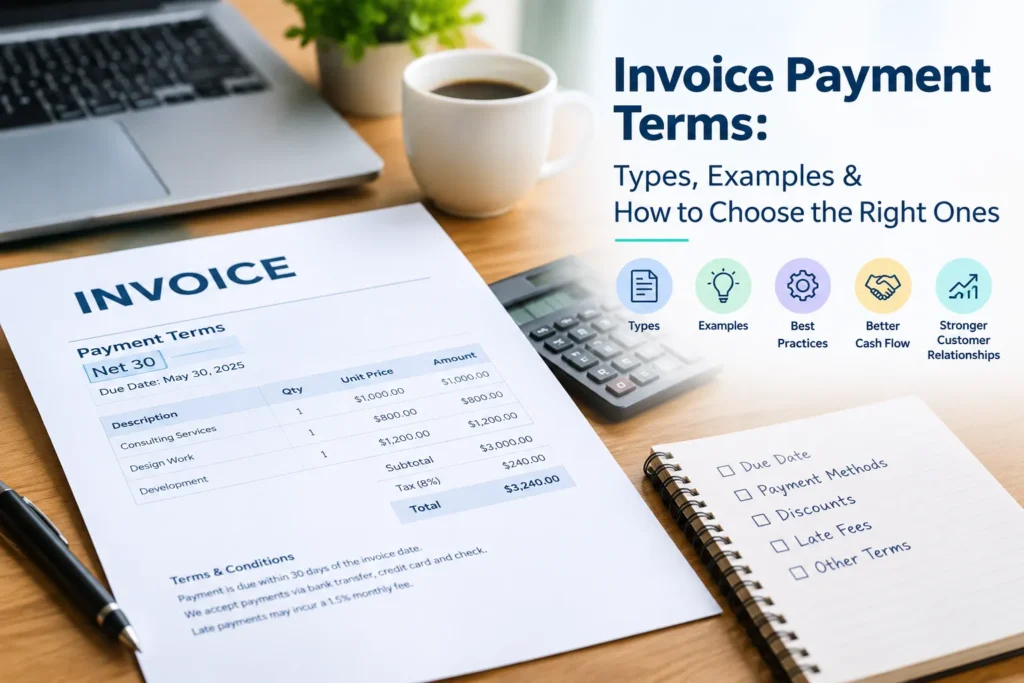
Choosing the right invoice payment terms is crucial for the success of your business. By clarifying payment terms, businesses set expectations on when and how customers should pay. Invoices without clear terms are often confused, delayed and followed up unnecessarily.
From small business to professional services and product sales, selecting the right payment terms can help enable a more consistent cash flow and smoothen customer relations.
What Are Invoice Payment Terms?
Invoice payment terms outline when the payment is due, what methods are acceptable for making payment and what will be done if payment is not made by the due date. These details will typically be stated directly on the invoice for the customer to understand what they have to do.
Common payment terms on an invoice include the due date, accepted payment methods, applicable discounts, late fees, and other relevant conditions.
Depending on your industry, customer relationships, transaction size and cash-flow requirements the right terms can vary.
What Are the Standard Invoice Payment Terms?
There are several standard payment terms businesses commonly use. There are some which require the immediate payment and some which allow a consumer a defined number of days to pay.
Common examples include:
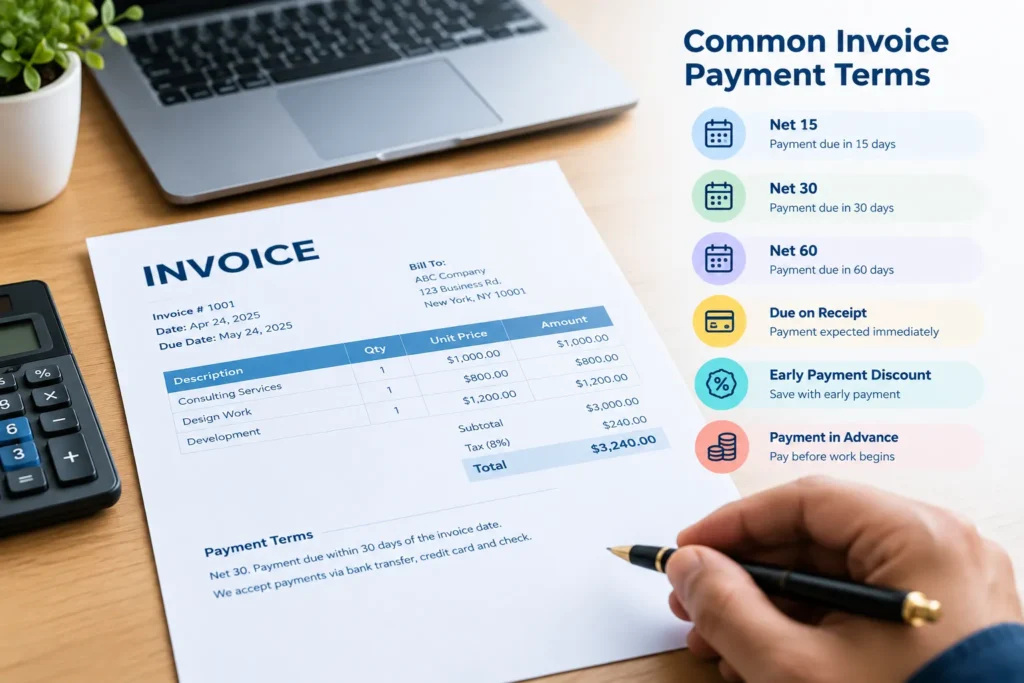
- Due on receipt: Payment is expected as soon as the invoice is received.
- Net 15: Payment is due within 15 days.
- Net 30: Payment is due within 30 days.
- Net 60: Payment is due within 60 days.
- 50/50 payment: Half is paid upfront and the remainder is due at an agreed milestone or completion date.
Net 30 payment terms are common for business-to-business transactions, but may not be suitable for every business.
What Are the Different Types of Payment Terms?
Type of payment terms may be flexible depending on your business and customer requirements.
Some companies will ask for a deposit prior to starting to work. Others employ milestone payments when working on bigger projects. Subscription companies could ask for a payment up front in each billing period.
Another alternative is to pay early payment discount terms. For instance, a company may provide a little discount for paying an invoice within a given amount of days. This can help to increase the speed of payment and provide a motivation to pay invoices early.
How to Choose Invoice Payment Terms
The first step in learning how to choose invoice payment terms is to consider your cash-flow needs and your customer base.
Consider:
- When you expect to be paid
- You would typically make a project or order of this size
- Customer payment history
- Industry expectations
- There are questions that need to be settled in advance, including whether or not a deposit is needed.
- The time and expense to provide the product or service
If you are a new customer or a larger project, you might be willing to take a deposit or milestones payments to limit financial risk. If you are an existing customer that has a good payment history, you might be able to afford extended terms.
Your business payment terms should be realistic, too. Very long payment periods may cause cash-flow tension if you have to pay your own costs sooner.
What Should Invoice Terms and Conditions Include?
You can avoid misunderstandings by clearly defining the invoice terms and conditions. Along with the payment date, it would be wise to specify accepted forms of payment, currency, payment in advance, discounts, taxes, and fees (if applicable).
The late payment terms on invoices should be clearly and explicitly communicated. If you have a late fee or interest rate, specify when it pertains and the rate. Ensure that any fees are in accordance with the law and customer contracts.
The purpose of creating the invoice is to make it easily understandable and not a lot of legal jargon.
Invoice Payment Terms Examples
Here are a few practical invoice payment terms examples:
Example 1 — Standard:
“Payment is due within 30 days of the invoice date.”
Example 2 — Due on receipt:
“Payment is due upon receipt of this invoice.”
Example 3 — Early payment discount:
“Receive a 2% discount when payment is made within 10 days. Full payment is due within 30 days.”
Example 4 — Project milestone:
“50% due before work begins. The remaining 50% is due upon project completion.”
Choose wording that clearly explains exactly when the customer needs to pay.
Conclusion:
Clear invoice payment terms bring more predictability of payments to businesses and customers. Net 30, payment on receipt, deposits, milestone billing or early payment incentives can all be utilized, but it is important that the terms are communicated so that everyone is clear.
Examine payment schedules periodically and select those most suitable to your cash flow that are reasonable for your customers.
Frequently Asked Questions
What are invoice payment terms?
Invoice payment terms describe when the customer needs to pay, what forms of payment are allowed, and if there are discounts, deposits or late payment fees.
What are the most common invoice payment terms?
Common terms are due on receipt, Net 15, Net 30, Net 60, upfront deposits, milestone payments and payment schedules, which are agreed to between the business and customer.
What are Net 30 payment terms?
The common exception to the Net 30 terms is that they might have a different term to start from – for example, it may be 60 days, 90 days, or even later, depending on what the business and customer have agreed to.
How do I choose invoice payment terms?
Take into account cash flow requirements, standard practice in your industry, customer history, project size, delivery schedule and deposits or payment by milestones.
Should small businesses use Net 30 terms?
Net 30 may be appropriate for companies that can count on their cash flow and dependable customers, while perhaps shorter terms or full payment may be better if cash flow is a concern.
What are early payment discount terms?
They provide the customer with a discount when they are paying before the due date. Invite the percentage of discount and also when it is due to be received should be clearly mentioned in the invoice.
What should payment terms on an invoice include?
They can include the payment due date, accepted payment methods, discounts, deposits, late fees, taxes, currency, and other conditions relevant to the transaction.
What are late payment terms on invoices?
They explain what happens when an invoice is not paid by its due date, such as applicable late fees or interest, subject to the agreement and applicable laws.
Can invoice payment terms be negotiated?
Yes. Businesses and customers can agree on different payment schedules, deposits, milestones, or due dates as long as the terms are clearly documented.
Why are clear invoice terms and conditions important?
Clear terms reduce misunderstandings, establish payment expectations, support cash-flow management, and give customers a straightforward reference for when and how to pay.