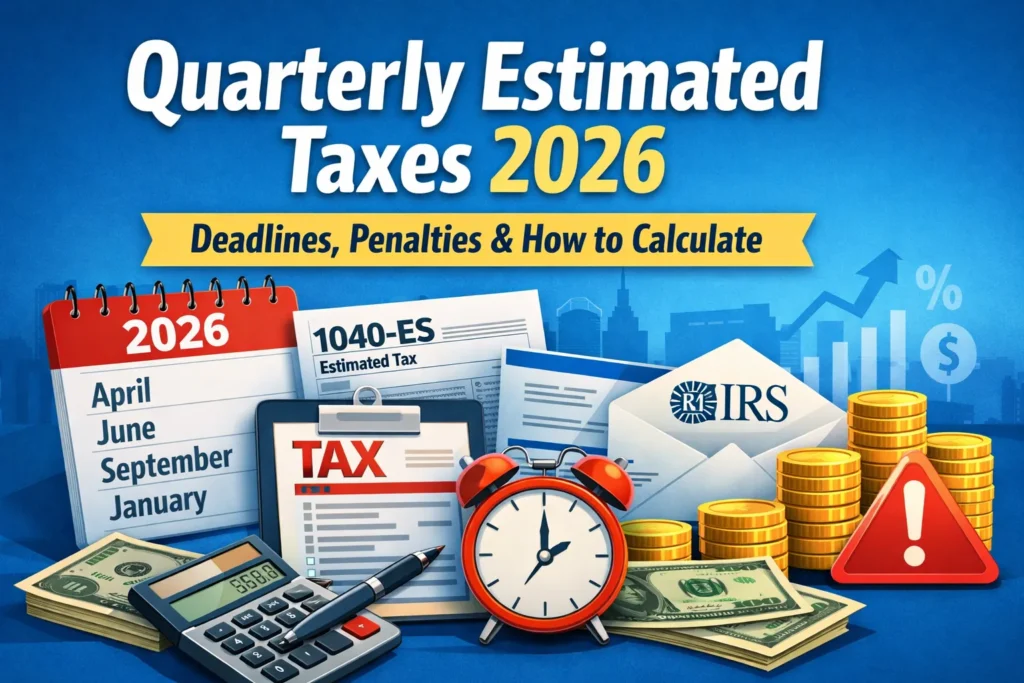
If you’re self-employed, freelancing, or running a small business, quarterly estimated taxes are those payments you make to the IRS four times a year. They are basically your way of replacing paycheck withholdings and avoiding one massive bill come April—instead, you spread it out nicely through the year.
In this guide, we’ll walk through who actually needs to pay these, how to figure out your quarterly amount, the key 2026 due dates, a straightforward way to calculate them, and what happens if you miss a deadline.
Who Needs Quarterly Estimated Taxes
Quarterly estimated taxes are usually for people who:
- Work for themselves (freelancers, consultants, gig workers).
- Get paid with 1099‑NEC instead of W‑2.
- Own a small business and do not get enough tax withheld from a paycheck.
- Have a lot of non‑wage income: investments, rentals, side gigs, etc.
If you expect to owe more than about $1,000 in tax after any withholdings and credits, you probably need quarterly estimated taxes.
Think of it like this: the IRS likes to get its money spread through the year instead of all at once in April. quarterly estimated taxes are how many independent earners do that.
How to Estimate Quarterly Taxes
Estimating quarterly taxes means guessing your total tax for the year and splitting it into four payments. Here’s a simple way:
- Look at last year’s return
Use your 2025 return to see your income, deductions, and tax paid. Adjust the numbers up or down if your 2026 income will be different. - Estimate your 2026 income and expenses
Add up what you expect to earn in 2026 and subtract your expected business and deductible expenses. This gives you estimated taxable income. - Use the 90% or 100% rule
Aim to pay at least 90% of your 2026 estimated tax in quarterly estimated taxes, or 100% of your 2025 tax (110% if your 2025 income was high). - Divide by four
Take your total estimated tax and split it into four equal parts. That becomes your quarterly tax payment for each quarter.
Most people use Form 1040‑ES to do this in a bit more detail.
2026 Estimated Tax Due Dates
Quarterly estimated taxes follow four fixed dates in 2026. The estimated tax due dates are:
- April 15, 2026
- June 15, 2026
- September 15, 2026
- January 15, 2027 (covers the fourth quarter of 2026)
These are also called quarterly tax payments dates or quarterly IRS payment dates.
If the 15th falls on a weekend or federal holiday, the payment is due the next business day. Write these dates in your calendar or set reminders.
How to Calculate Quarterly Taxes
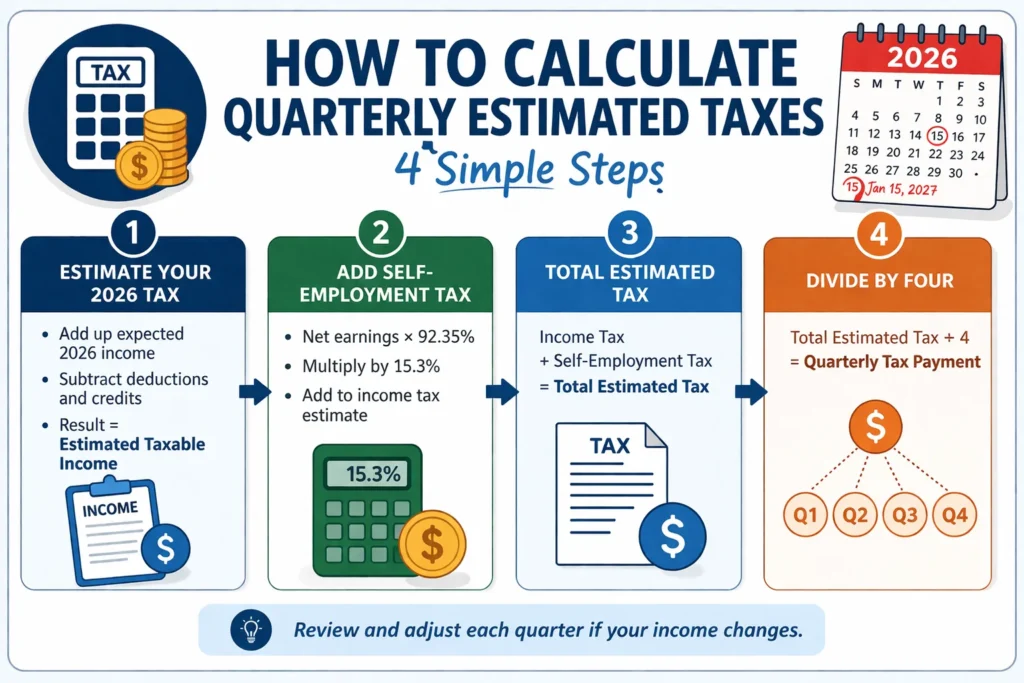
Here is a straightforward way to calculate quarterly taxes so they match what you owe.
- Estimate your total 2026 tax
Add up expected 2026 income: self‑employment, wages (if any), investments, rental, side income.
Subtract deductions and credits (standard or itemized, retirement contributions, self‑employment tax deduction).
This gives you estimated taxable income. - Add self‑employment tax (if self‑employed)
Take net self‑employment income, multiply by about 92.35%, then by 15.3% to get self‑employment tax.
Add this to your regular income‑tax estimate to get your total estimated tax for the year. - Split into four payments
Take the total estimated tax and divide by four.
That gives you a simple quarterly tax payment for each quarter.
You can adjust one quarter up or down if your income is uneven.
How to File Quarterly Taxes Without Stress
Filing quarterly taxes does not mean submitting a full return every quarter. It usually means:
- Using Form 1040‑ES to figure out your quarterly estimated taxes.
- Sending the payment to the IRS by the correct quarterly tax payments dates.
You can pay:
- Electronically through IRS Direct Pay or another IRS‑approved system.
- Or by check or money order with the payment voucher from Form 1040‑ES.
You are just sending installments of your yearly tax bill.
Deadlines and What Happens If You Miss Them
Because quarterly estimated taxes follow fixed 2026 estimated tax due dates, missing them can cost money.
If you miss a quarterly tax payment:
- The IRS usually charges interest on the unpaid tax.
- You may also face a failure‑to‑pay penalty, a percentage of the unpaid amount for each month it stays unpaid.
Treat these dates like bills: set reminders or automatic payments so you do not forget.
How to Get Estimated Tax Liability in Advance
People often want to know how much tax liability they will owe before the year ends.
Here is how to get estimated tax liability in advance:
- Use your 2025 tax return as a template and plug in 2026 income and expense numbers.
- Use tax software or a simple spreadsheet to see how your total tax changes.
- Talk to a tax pro who can help you estimate your tax liability in advance and set up a safe payment plan.
This way, you avoid surprises in April.
Frequently Asked Questions
What are quarterly estimated taxes?
So, imagine you’re at a regular job, clocking in, getting that paycheck. The IRS automatically withholds taxes from employee paychecks. But you? Freelancer, side-hustle warrior, small biz boss? They don’t do that magic for you. Enter quarterly estimated taxes. No massive hit in April, no “oops, penalties” surprise. Smart move, right?
Tell me—do I even need to bother with these?
Straight up: If you’re staring down $1,000 or more owed at tax time—after all your withholdings, credits, refunds get subtracted—then yep, this is your gig. We’re talking self-employment cash, those DoorDash runs, rental income trickling in, stock dividends. Salaried life? You might dodge it.
When do I actually have to send these for 2026?
Easy list: April 15 kicks it off, June 15 next, September 15, and wrap with January 15, 2027. It slides to Monday or whenever business days resume. I swear, block ’em in your calendar now; it’ll save your bacon.
Alright, how the heck do I calculate what to pay each time?
Chop out deductions—home office square footage, gas for client meetings, all that. Credits? Subtract them. Self-employed? Slap on 15.3% for Social Security and Medicare. Total tax number in hand? Slice it into quarters. That’s payment one, two, three, four. Adjust if life throws curves.
My income’s jumping around—what then?
Happens to everyone. Q1 explodes with clients, Q2 dries up? Stop, re-crunch the year-end estimate with fresh numbers, pay what fits now. IRS gets it—flexibility’s baked in. No rigid “same every time” rule.
I miss a payment—what’s the damage?
Oof, not ideal. Interest clock starts ticking that second on the late amount. Then bam—failure-to-pay penalty, 0.5% a month or even part-month. It creeps up like compound interest on a bad loan. Moral? Don’t let it happen.
How do I guess my 2026 taxes early?
Your 2025 tax return is the foundation for estimating your 2026 taxes. Minutes later? Full breakdown, quarterly splits, all laid out. Game-changer.
Form 1040-ES—deal breaker or not?
Skip it for paying. Log into IRS Direct Pay, punch numbers, hit send. Or EFTPS, bank transfer—zero paper. Form’s just your calculator and proof sheet. Handy, but not mandatory.
Can I straight-up avoid these payments?
Couple escapes. Withholdings from a part-time job cover 90% of 2026 total? You’re free. “Safe harbor” too: Match 100% of 2025 tax paid (110% if you cleared $150K AGI). Your income cocktail decides—IRS site spells it out.