
As transactions grow, financial records become harder to manage. At that point, professional bookkeeping becomes essential for maintaining accurate financial record management, understanding profits, and keeping cash flow tracking under control.
The real challenge is understanding pricing. Some bookkeepers charge hourly rates, others offer monthly packages, and many firms now provide outsourced solutions with fixed pricing.
This guide explains bookkeeping services prices, what influences the cost of bookkeeping services, typical bookkeeper cost per hour, and how businesses can estimate the real bookkeeping cost for small business operations in 2026.
What Bookkeeping Actually Includes
Before understanding pricing, it helps to know what services are included in bookkeeping.
Professional bookkeeping typically covers several financial tasks that keep business records organized and compliant.
Common services include:
- Recording daily transactions
- Bank and credit card reconciliation
- Expense categorization
- Cash flow tracking
- Payroll entry and adjustments
- Preparing monthly reports
- Maintaining organized financial records
- Supporting accountants during tax preparation
Many small companies rely on small business bookkeeping services to handle these tasks so owners can focus on running the business.
Because the level of support can vary, the bookkeeping cost for small business will depend on how many of these services are required.
Average Bookkeeping Costs in 2026
Bookkeeping pricing continues to evolve as more businesses move toward cloud accounting and automation. However, the general pricing ranges remain consistent across most industries.
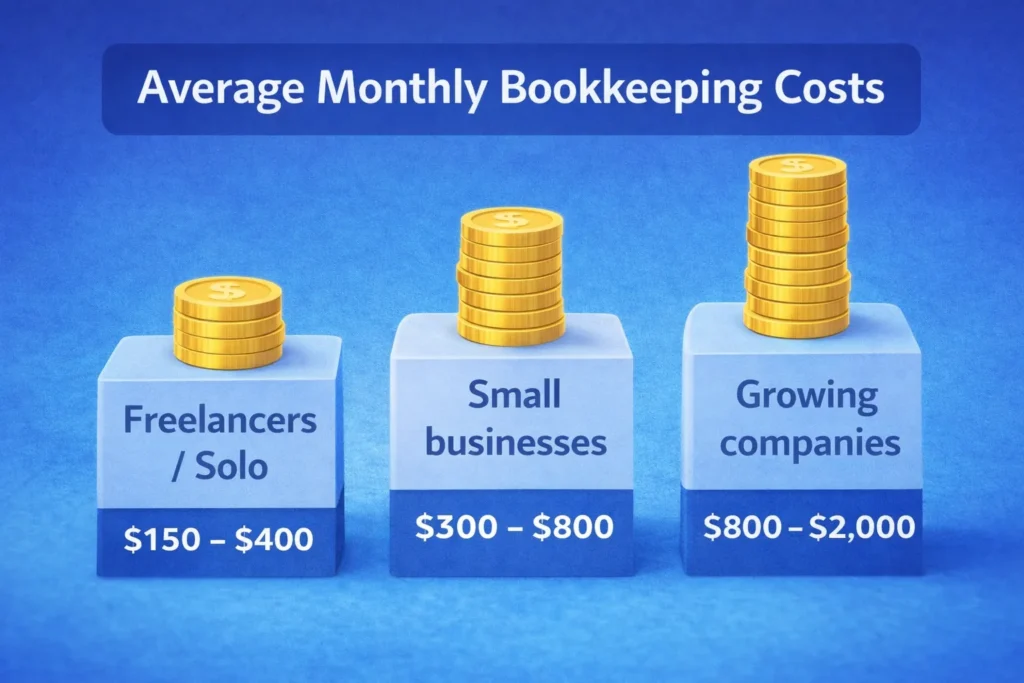
Average Monthly Bookkeeping Costs
| Business Size | Monthly Cost Range |
| Freelancers / Solo | $150 – $400 |
| Small businesses | $300 – $800 |
| Growing companies | $800 – $2,000 |
| High transaction businesses | $2,000+ |
For most companies, the bookkeeping cost for small business typically falls between $300 and $800 per month.
This price usually covers transaction categorization, reconciliations, and basic reporting.
Businesses with larger volumes of transactions will see a higher bookkeeping cost for small businesses due to the additional time required to manage accounts.
Bookkeeper Cost Per Hour
Some businesses prefer hourly bookkeeping instead of monthly packages.
The typical bookkeeper cost per hour in 2026 ranges between:
| Experience Level | Hourly Rate |
| Beginner bookkeeper | $20 – $35 |
| Experienced bookkeeper | $35 – $60 |
| Professional bookkeeping firm | $60 – $120 |
Hourly billing works well for occasional bookkeeping tasks. However, ongoing monthly work often becomes more expensive with hourly pricing.
That is why many companies switch to fixed monthly small business bookkeeping services, which provide predictable budgeting.
Even when hourly billing is used, the final bookkeeping cost for small business depends on how many hours are required each month.
Outsourced Bookkeeping Cost
Outsourcing has become one of the fastest growing solutions for small businesses.
Instead of hiring an in-house employee, companies hire external bookkeeping providers to manage their finances remotely.
Typical outsourced bookkeeping cost ranges:
| Service Level | Monthly Cost |
| Basic bookkeeping | $250 – $500 |
| Standard bookkeeping | $500 – $1,200 |
| Advanced financial management | $1,200 – $3,000 |
The advantage of outsourcing is that businesses gain access to experienced professionals without paying full-time salaries.
For many companies, outsourcing significantly reduces the overall bookkeeping cost for small business while improving financial accuracy.
Factors That Affect Bookkeeping Pricing
Not every company pays the same price for bookkeeping. Several factors influence the cost of bookkeeping services.
1. Number of Monthly Transactions
Businesses with hundreds of transactions require more time to reconcile accounts and categorize expenses.
Higher transaction volume increases the bookkeeping cost for small business because it requires more detailed work.
2. Business Complexity
Businesses with multiple revenue streams, inventory, or payroll systems need more complex bookkeeping.
These companies usually require advanced financial reporting services, which can increase monthly pricing.
3. Payroll Processing
If bookkeeping services include payroll management, costs typically increase due to tax calculations and compliance requirements.
4. Catch-Up Bookkeeping
Businesses that fall behind on bookkeeping often require catch-up work.
This can temporarily increase the bookkeeping cost for small business until records are fully organized.
5. Software Integration
Integrating accounting platforms, payment systems, and inventory tools may also influence the overall cost of bookkeeping services.
Monthly vs Hourly Bookkeeping Pricing
Businesses often choose between two common pricing models.
Monthly Bookkeeping Packages
Monthly pricing is the most popular option.
Advantages include:
- Predictable bookkeeping services prices
- Consistent financial updates
- Easier budgeting
- Regular financial reporting services
Monthly services usually offer better long-term value compared to hourly billing.
Hourly Bookkeeping
Hourly billing works best for:
- One-time financial cleanup
- Temporary support
- Occasional reporting tasks
However, the bookkeeping cost for small business can become unpredictable with hourly pricing because workload changes each month.
What Small Businesses Should Expect to Pay
Most businesses want a simple estimate.
For the majority of companies, the bookkeeping cost for small business falls within these ranges:
- Basic bookkeeping: $300 – $500 per month
- Standard bookkeeping: $500 – $900 per month
- Advanced bookkeeping: $900 – $2,000 per month
Understanding the real bookkeeping cost for small business helps owners plan financial operations more effectively.
Signs a Business Needs Professional Bookkeeping
Many small businesses delay bookkeeping until financial problems appear.
Some clear signs that professional bookkeeping is needed include:
- Business owners cannot track expenses properly
- Financial reports are unavailable or inaccurate
- Tax preparation becomes stressful
- Bank accounts are not reconciled monthly
- Cash flow problems appear unexpectedly
How to Reduce Bookkeeping Costs
Although bookkeeping is essential, businesses can still control expenses.
Here are some practical ways to reduce the bookkeeping cost for small businesses.
Organize Receipts
Keep receipts tidy to cut bookkeeping time.
Less mess means lower bookkeeping services prices.
Use Accounting Software
Cloud tools auto-import and sort transactions.
This drops the cost of bookkeeping services.
Schedule Regular Updates
Do monthly updates to avoid backlog fees.
No catch-up work saves on bookkeeping costs for small businesses.
Pick Right Service Level
Pay only for needed services.
Basic financial record management works for small setups
Why Accurate Bookkeeping Matters
Bookkeeping is more than simple data entry. It provides essential financial visibility.
Accurate bookkeeping helps businesses:
- Monitor cash flow tracking
- Understand profitability
- Prepare for taxes
- Plan financial growth
Frequently Asked Questions
What is the average bookkeeping cost for small business?
Bookkeeping cost for small business averages $300-$800 monthly. It depends on transactions, reports, and record complexity.
How much does a bookkeeper cost per hour?
Bookkeeper cost per hour runs $20-$120. Rates vary by skill, location, and if it’s a solo pro or firm.
What affects bookkeeping services prices most?
Transaction count, payroll, financial complexity, and reports drive bookkeeping services prices highest.
Is outsourced bookkeeping cost cheaper than in-house?
Yes, outsourced bookkeeping cost saves big by skipping salaries, benefits, and training costs.
How often should bookkeeping update?
Update books monthly for solid cash flow tracking, timely insights, and smooth tax prep.
Can bookkeeping improve cash flow tracking?
Yes, good bookkeeping boosts cash flow tracking by watching money in and out for smarter choices.
What reports do bookkeepers make?
Bookkeepers deliver financial reporting services like profit/loss, balance sheets, and cash flow reports.
Is bookkeeping needed for small businesses?
Yes, small businesses require financial record management to track income, expenses, and taxes right.
When to hire small business bookkeeping services?
Hire small business bookkeeping services when records get messy or reports are key for decisions.
Can bookkeeping cut tax issues?
Yes, proper bookkeeping keeps records clean and compliant, easing taxes and dodging penalties.