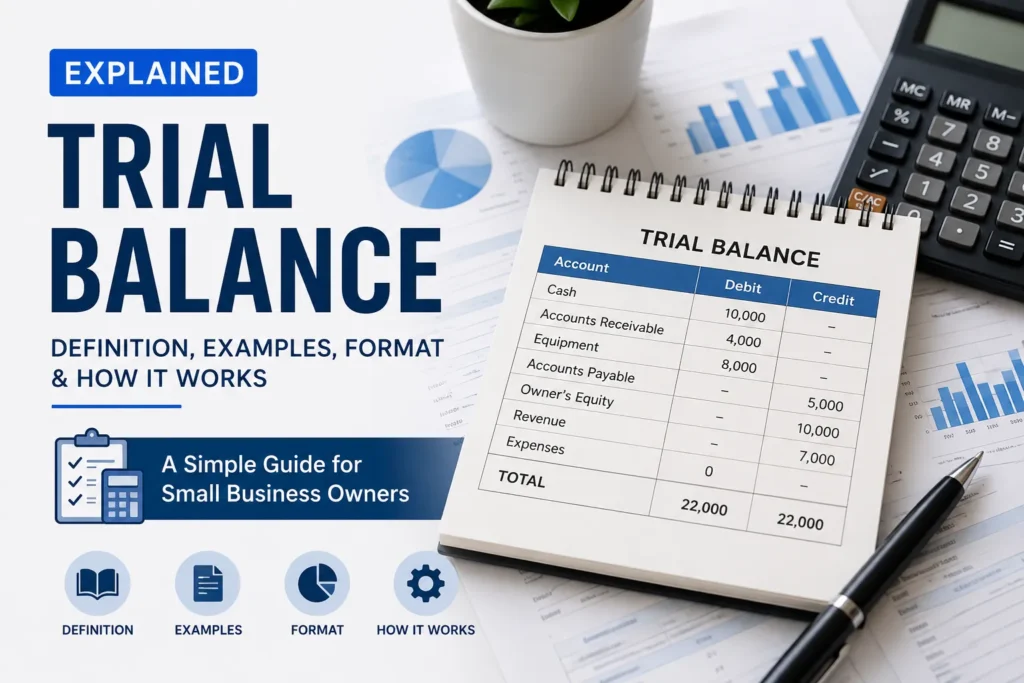
A trial balance is an important accounting report. It is typically produced prior to financial statements and can be helpful in uncovering various errors of recording or posting.
Th process becomes easier to understand if it is understood because it helps in the explanation of how the transactions transfer into the financial statements.
This guide will explain what a trial balance is, its function, how you prepare it and how it is different from a balance sheet.
What is a Trial Balance?
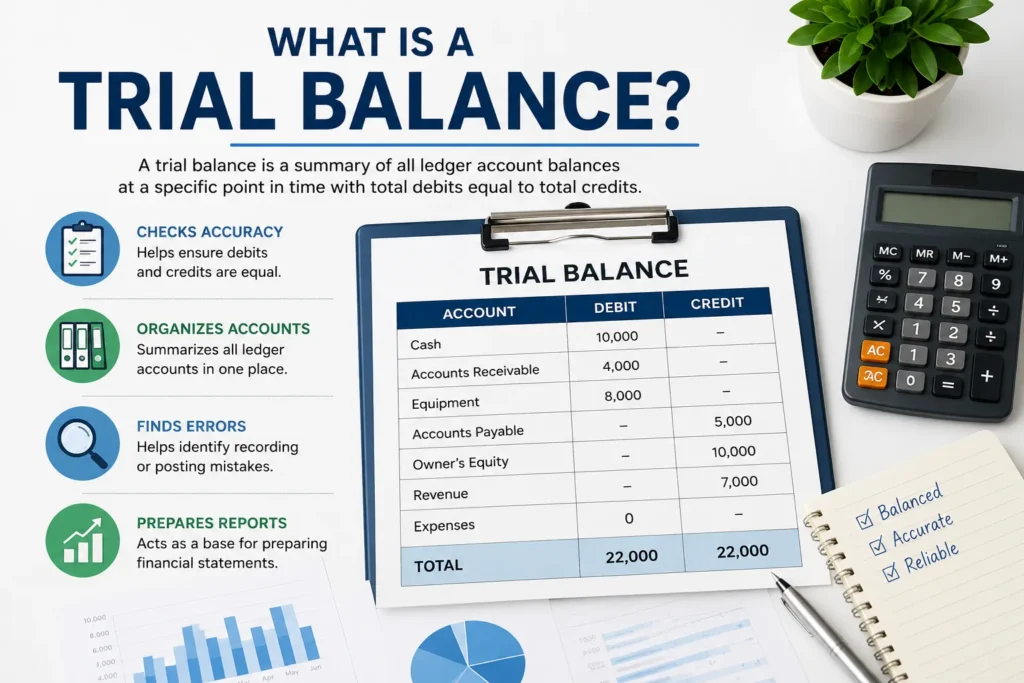
It is a list of the balances of ledger accounts at a particular time. Debit balances are entered in one column, credit balances in another.
In accounting, the sum of the two sides of a trial balance should be equal, except when there are errors in the records. In case they aren’t identical, the accounting records must be examined for any errors in them.
A trial balance is not a financial statement. Rather, it is an accounting tool that is used internally before preparing reports like the income statement and balance sheet.
What is the Purpose of a Trial Balance?
The primary function of a balance is to verify that the debits are equal to the credits after posting all the transactions to the ledger. It can provide assistance to accountants:
- Review your debit and credit totals.
- Identify certain posting errors
- Organize ledger balances
- Prepare financial statements
- Check balances prior to adjustments
A balanced accounting trial balance, however, does not ensure all the accounting entries are correct. There can still be errors where the total for the two sides of the ledger is the same.
What is the Trial Balance Format?
A basic trial balance format usually includes the account name, account number if applicable, debit balance, and credit balance.
| Account | Debit | Credit |
| Cash | $10,000 | — |
| Accounts Receivable | $4,000 | — |
| Equipment | $8,000 | — |
| Accounts Payable | — | $5,000 |
| Owner’s Equity | — | $10,000 |
| Revenue | — | $7,000 |
| Expenses | $0 | — |
| Total | $22,000 | $22,000 |
The exact layout may differ depending on the accounting system or business.
What is a Trial Balance Example?
Assume that a business has cash of $5,000, equipment of $3,000, accounts payable of $2,000, and owner’s equity of $6,000. These accounts might appear as a simple balance with the items in the proper debit and credit column.
Assets (such as cash and equipment) would show up as debit balances and liabilities and equity would be credit balances. What matters here is that the total of debits is equal to the total of credits.
How to Prepare a Trial Balance
Knowing how to prepare a trial balance starts with reviewing the ledger accounts.
Follow these steps:
- Make entries in business books, journals.
- Record the transactions on the ledger.
- Find the balance of each ledger account.
- Enter the accounts.
- Enter debit balances in the DEBIT column.
- Place credit balances in the credit column.
- Add both columns together and check that they equal.
If the totals differ, check the totals and the entries in the ledger for errors.
What are Trial Balance Adjustments?
In some cases, accounting records must be adjusted prior to the preparation of financial statements. These are referred to as balance adjustments.
Some adjustments may be required for items like:
- Accrued expenses
- Prepaid expenses
- Depreciation
- Accrued revenue
- Unearned revenue
Once these adjustments are made, an adjusted balance can be drawn up.
What is an Adjusted Trial Balance?
An adjusted trial is prepared when adjusting entries have been posted to the ledger.
It records current account balances which can be used to prepare financial statements.
It is given below:
Assume that a business paid $1,200 for insurance that has been prepaid. $200 has been used at the end of the accounting period.
The insurance expense would be recognized as $200 and prepaid insurance would be decreased by the $200. The balances that would then be obtained on the trial balance would be the adjusted balances.
This facilitates the recognition of revenues and expenses in the right accounting period in order to ensure that the accounts are balanced.
What is the Difference Between Trial Balance and Balance Sheet?
The trial balance vs balance sheet comparison is important because the two reports serve different purposes.
| Trial Balance | Balance Sheet |
| Internal accounting report | Financial statement |
| Lists ledger account balances | Reports assets, liabilities, and equity |
| Includes revenue and expense accounts | Does not normally show individual revenue and expense accounts |
| Helps check debit and credit equality | Shows financial position |
| Used before financial statements | Part of financial reporting |
Conclusion
A trial balance assists companies to arrange ledger balances and to make sure that the total debits are equal to the total credits. It also serves as a good starting point for future adjustments and preparing financial statements.
The knowledge of the format of its adjustments and differences facilitates the accounting process and can make it easier to follow and review.
Frequently Asked Questions
What is a trial balance?
It is an accounting report which shows ledger account balances in debit and credit columns. Its primary function is to verify that the total debit and credit balances are the same.
What is the purpose of a trial balance?
It is used to verify that the debit balances must equal the credit balances after transactions have been posted. It can also be useful to arrange the accounts information prior to accounts preparation.
What is a trial balance example?
It includes accounts, including cash, accounts receivable, equipment, accounts payable, revenue, expenses, and equity, with balances shown in the appropriate debit or credit column.
What is a trial balance in accounting?
It is a procedure that involves the addition of the balances of all the ledger accounts and the comparison of the total of all the debits with the total of all the credits. It is an accounting procedure and not a financial statement.
How do you prepare a balance?
A balance is made by calculating the balance of each ledger account, listing all of the accounts, putting the balance of the debit and credit sides into the appropriate columns and checking that the columns add up to the same number.
What is a trial balance format?
A typical trial balance format contains the names of accounts and separate columns for the debits and credits. Some companies also incorporate account numbers and the date or accounting period that the report is for.
What are trial balance adjustments?
Trial balance adjustments are entries made to the balance to adjust account balances, including depreciation, accrued expenses, prepaid expenses, or revenue which has been earned but not yet recorded.
What is an adjusted trial balance?
An adjusted balance is prepared after adjusting entries have been recorded. It contains updated ledger balances and is commonly used as the basis for preparing financial statements.
What is an example of balance with adjustments?
An example of balance with adjustments could show a prepaid expense being reduced after part of the service has been used, with the corresponding amount recorded as an expense before the adjusted balances are prepared.
What is the difference between balance and balance sheet?
The trial balance vs balance sheet difference is that a balance lists ledger balances to check accounting records, while a balance sheet reports a company’s assets, liabilities, and equity at a specific date.