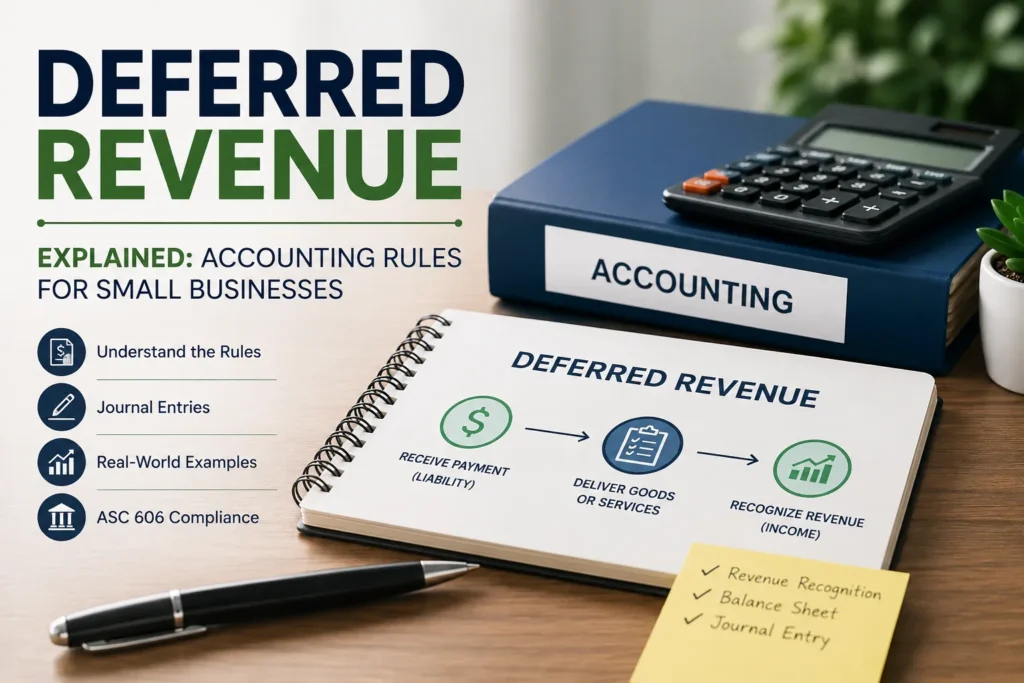
Getting paid upfront feels great. The cash is in the bank. But here is the catch. That money is not yet yours to count as revenue. Not until you actually deliver what you promised. Deferred revenue is one of those accounting concepts that trips up small business owners all the time. You have the cash. You want to call it income. But the rules say otherwise.
What is Deferred Revenue
It is money your business receives before you deliver the goods or services. It is an advance payment. A prepayment. A deposit. You see the word “revenue” and think income. But it is actually a liability on your balance sheet. You owe the customer something. Until you deliver, that money is not earned.
Unearned revenue means the exact same thing. Same concept. Different name. Both refer to cash collected before the work is done.
Why Does Revenue Matters?
Revenue recognition rules require you to record revenue when it is earned, not when cash arrives. This is the core of accrual accounting.
If you treat upfront payments as immediate income, your financial statements look inflated. You show profit you have not actually earned. This is misleading and can get you in trouble with tax authorities or investors.
Deferred revenue liability represents an obligation. You owe your customer a product or service. If you fail to deliver, you must refund the money.
How Deferred Revenue Works
The process follows a simple pattern.
- Step 1: Receive payment. Record the cash and set up a liability.
- Step 2: Deliver the goods or services. Reduce the liability and recognize revenue.
- Step 3: Repeat until the obligation is fully satisfied.
Here is a deferred revenue example. A customer pays $1,200 for a 12-month software subscription. On day one, you record:
– Debit Cash $1,200
– Credit revenue $1,200
Each month, you deliver one month of service. You recognize $100 of revenue:
– Debit revenue $100
– Credit Revenue $100
After 12 months, the liability is zero. All $1,200 is now earned revenue.
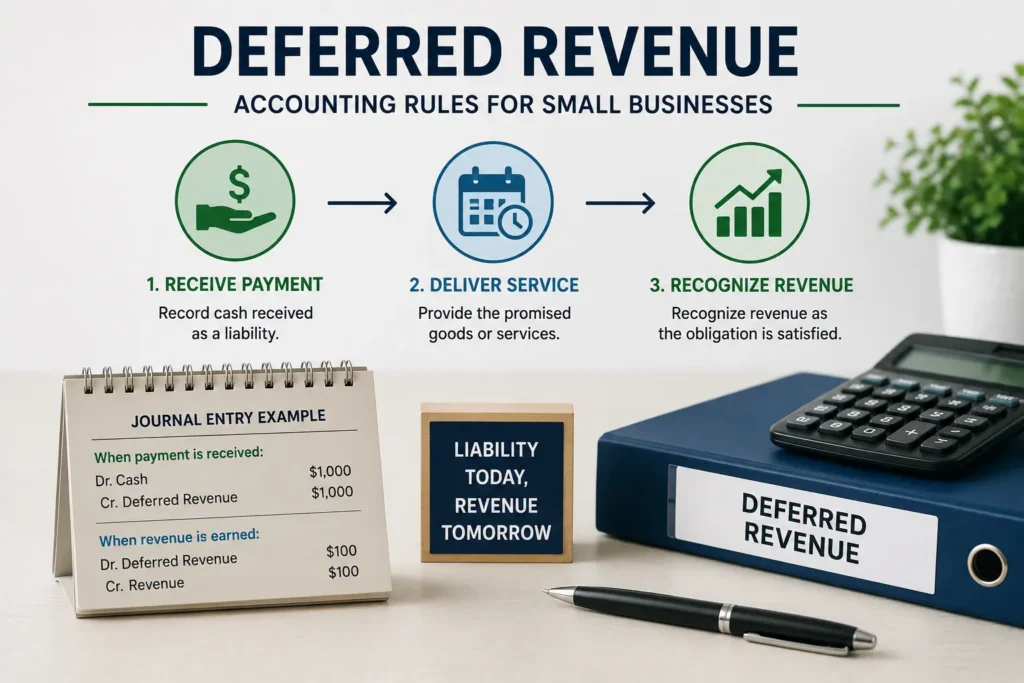
Deferred Journal Entry
The deferred revenue journal entry is straightforward.
Initial entry upon receiving payment:
– Debit: Cash
– Credit: revenue (liability account)
Recognizing revenue as you deliver:
– Debit: Deferred revenue
– Credit: Revenue (income statement account)
This is the standard revenue accounting entry.
Revenue on the Balance Sheet
Deferred revenue balance sheet classification depends on timing. If the obligation will be fulfilled within 12 months, it is a current liability. If it extends beyond 12 months, a portion may be long-term liability. It sits alongside accounts payable, accrued expenses, and other obligations.
Deferred Example: Common Scenarios
- SaaS subscriptions. Annual payment for monthly software access. Revenue recognized each month.
- Gym memberships. Annual fee for 12 months of access. Revenue recognized monthly.
- Gift cards. Customer buys a card. Revenue recognized when the card is redeemed for goods.
- Legal retainers. Client pays upfront. Revenue recognized as hours are worked.
- Magazine subscriptions. Payment for future issues. Revenue recognized as each issue is delivered.
- Service contracts. Annual maintenance agreement. Revenue recognized monthly as service is provided.
ASC 606 Revenue Recognition
ASC 606 revenue recognition is the standard for businesses following GAAP. It requires you to recognize revenue when you transfer promised goods or services to the customer.
ASC 606 means you must identify performance obligations and recognize revenue as each obligation is satisfied. This often means spreading revenue over the contract term rather than recognizing it all upfront.
Small businesses using GAAP-compliant financial statements must follow ASC 606.
Managing Deferred Revenue
- Create a revenue recognition schedule: Map out when revenue will be recognized for each contract.
- Review balances monthly. Confirm that deferred revenue balances still reflect outstanding obligations.
- Use accounting software. Manual tracking does not scale. QuickBooks and Xero have tools for management.
- Document everything. Contracts, invoices, and recognition schedules should link directly to journal entries.
Common Mistakes
Recording revenue as income too early. This overstates profit and understates liabilities. Forgetting to recognize revenue over time. Some businesses take the upfront cash and never move it to earned revenue. Misclassifying revenue on the balance sheet. It is a liability, not an asset or equity. Failing to adjust for cancellations or refunds. When a contract ends early, deferred revenue must be reversed.
Conclusion
Deferred revenue is not complicated. It is simply money you have received but have not yet earned. Record it as a liability. Recognize it as revenue when you deliver.
Getting this right keeps your financial statements accurate. It prevents surprises at tax time. It builds trust with investors and lenders.
Revenue recognition rules exist for a reason. Follow them. Your business will be stronger for it.
Frequently Asked Questions
What is deferred revenue ?
It is money you receive from a customer before you deliver the product or service. It is a liability on your balance sheet because you still owe something to the customer.
Is revenue a liability or an asset?
It is a liability. It represents an obligation to provide goods or services in the future.
What is the difference between deferred revenue and unearned revenue?
There is no difference. They are the same thing. “Unearned revenue” is an older term. “Deferred revenue” is more common now. Both mean payment received before the work is done.
How do I record revenue in a journal entry?
When you receive payment, debit Cash and credit Revenue (a liability). When you deliver the goods or services, debit Revenue and credit Revenue.
What are common examples of revenue?
SaaS subscriptions, gym memberships, gift cards, legal retainers, magazine subscriptions, and annual service contracts are all common examples.
Is deferred taxable income?
Under accrual accounting, revenue is taxed when it is recognized, not when cash is received. Under cash accounting, it is taxed when cash hits the bank.
What happens to revenue if the service is never delivered?
That revenue liability gets reduced, and you don’t get to count it as income. No service delivered? No revenue recognized.
How does ASC 606 affect revenue?
ASC 606 makes you break down your contract into specific performance obligations, and you can only recognize revenue as each one gets done.
Where does deferred revenue appear on the balance sheet?
It lives in the liabilities section. If you’re going to deliver within 12 months, it’s a current liability. If it’s gonna take longer, a chunk of it may be long-term. Either way, it’s not yours to keep yet.