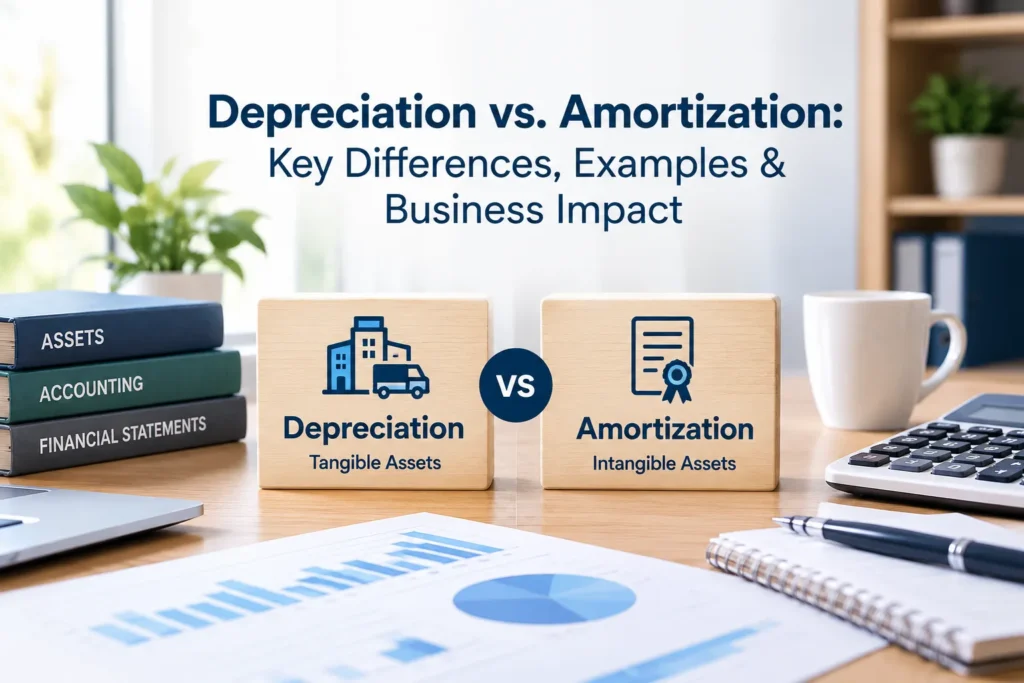
Businesses purchase assets such as vehicles, machinery, software, and patents to support long-term operations. Instead of recording the entire cost as an expense immediately, accounting rules generally spread it over the asset’s useful life. This process is called depreciation or amortization.
Understanding depreciation vs amortization helps business owners track expenses, interpret financial statements, and make better financial decisions.
What is Depreciation in Accounting?
Depreciation in accounting allocates the cost of a tangible asset over its useful life. Examples include vehicles, machinery, computers, and office furniture.
For example, a business purchases equipment for $20,000 and expects to use it for five years with no residual value. Using the straight-line method, it records $4,000 in annual depreciation expense.
What is Amortization in Accounting?
Amortization in accounting spreads the cost of a finite-lived intangible asset over its useful life. Examples include patents, copyrights, and qualifying software assets.
If a company purchases a patent for $15,000 with a five-year useful life and no residual value, it may record $3,000 in annual amortization expense using the straight-line method.
Difference Between Depreciation and Amortization
The main difference between depreciation and amortization is the type of asset involved.
| Feature | Depreciation | Amortization |
| Asset type | Tangible assets | Intangible assets |
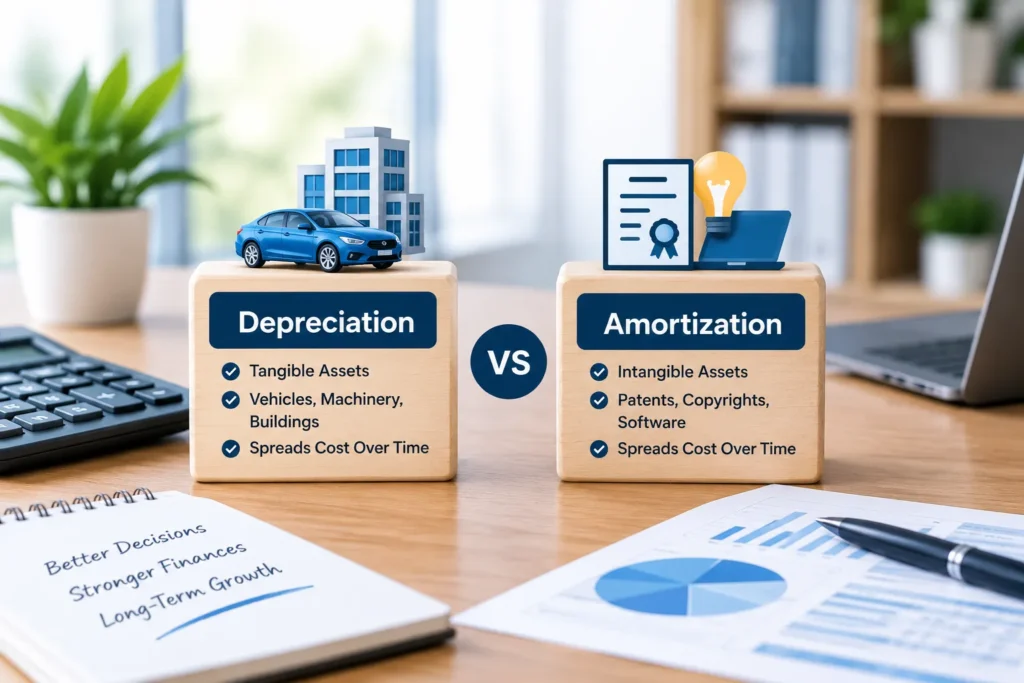
| Examples | Vehicles, machinery, buildings | Patents, copyrights, software |
| Purpose | Allocates cost over useful life | Allocates cost over useful life |
| Common method | Straight-line or accelerated | Often straight-line |
Both expenses generally reduce accounting profit without requiring a new cash payment when recorded. Tax treatment may differ from financial accounting rules.
Depreciation and Amortization Examples
These depreciation and amortization examples show how businesses calculate annual expenses.
Depreciation example: A delivery van costs $30,000, has a $5,000 residual value, and a five-year useful life.
Calculation: ($30,000 − $5,000) ÷ 5 = $5,000 annually.
Amortization example: A patent costs $12,000 and has a four-year useful life with no residual value.
Calculation: $12,000 ÷ 4 = $3,000 annually.
These calculations assume the straight-line method and unchanged estimates.
Understanding the Useful Life of a Business Asset
The useful life of a business asset is the period during which a company expects to benefit from it. Tangible assets may wear out or become outdated, while intangible assets may be limited by legal protections, contracts, or market conditions.
Businesses should review useful-life estimates and residual values when circumstances change. Intangible assets with indefinite useful lives generally are not amortized under certain accounting frameworks but may require impairment testing.
How Depreciation and Amortization Affect Financial Statements
Depreciation and amortization on financial statements affect profitability, asset values, and cash flow.
- Income statement: Both expenses generally reduce reported profit.
- Balance sheet: They reduce the carrying value of the relevant assets over time.
- Cash flow statement: Under the indirect method, they are commonly added back to net income when calculating operating cash flow because they are generally non-cash expenses.
Accurate accounting helps businesses evaluate performance and plan future investments.
Common Mistakes to Avoid
Businesses should avoid these common errors when recording asset expenses:
- Applying depreciation to intangible assets or amortization to the wrong asset category.
- Estimating an unrealistic useful life.
- Ignoring residual value when calculating depreciation.
- Confusing tax deductions with financial accounting expenses.
- Overlooking impairment when an asset loses value unexpectedly.
Conclusion
Depreciation and amortization spread asset costs over the periods in which businesses benefit from them. The key difference is that depreciation generally applies to tangible assets, while amortization applies to finite-lived intangible assets.
Understanding depreciation vs amortization helps businesses maintain accurate financial records, assess profitability, and plan investments more effectively.
Frequently Asked Questions
What is the main difference between depreciation and amortization?
Depreciation generally applies to tangible assets, while amortization generally applies to finite-lived intangible assets.
What assets are depreciated?
Common examples include machinery, vehicles, computers, furniture, and buildings.
What assets are amortized?
Examples include patents, copyrights, and qualifying software or other finite-lived intangible assets.
Are depreciation and amortization cash expenses?
They are generally non-cash expenses when recorded, although purchasing the asset usually involves a cash outflow.
How do these expenses affect profit?
Both typically reduce reported profit by allocating a portion of an asset’s cost to each accounting period.
Is land depreciated?
Land generally is not depreciated because it usually has an indefinite useful life. Certain land improvements may be depreciable.
Are all intangible assets amortized?
No. Intangible assets with indefinite useful lives generally are not amortized under certain accounting frameworks but are assessed for impairment.
Where do these expenses appear on financial statements?
They affect expenses and profit on the income statement, reduce asset values on the balance sheet, and are commonly added back when calculating operating cash flow under the indirect method.