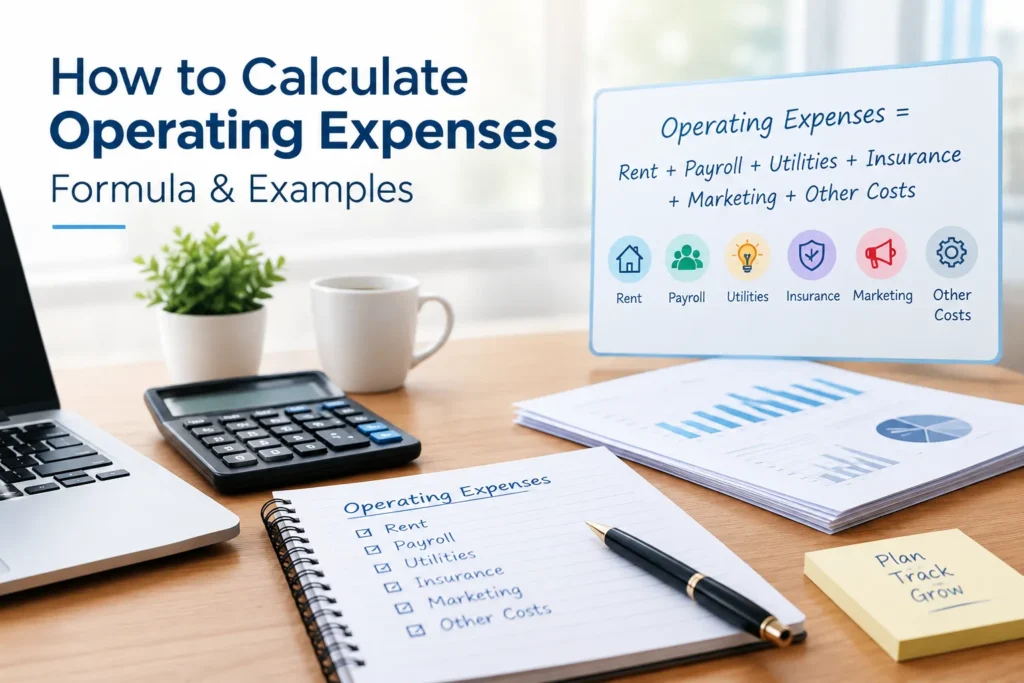
How to calculate operating expenses is a common question when business owners want a clearer picture of where their money goes. Rent, payroll, software, insurance, marketing, and other recurring costs can quickly add up.
Tracking operating expenses is important because these costs affect a business’s budget, cash flow, pricing decisions, and profitability. Once these costs are determined, other things become easy to find, and their correct calculation helps in understanding.
What Are Operating Expenses?
An operating expense is any kind of expense that happens throughout the duration of a business. These could range from rent, administrative payroll, utilities, insurance, advertising, software, office supply, etc. These are usually separate from direct production costs (COGS). This helps businesses to improve their visibility of how they’re doing in the business.
What is the Operating Expenses Formula?
The basic operating expenses formula is:
Operating Expenses = Rent + Payroll + Utilities + Insurance + Marketing + Other Operating Costs
A company with a rent bill of $2,000, administrative payroll of $5,000, utilities of $400, and marketing of $600, for instance:
$2,000 + $5,000 + $400 + $600 = $8,000
Use the same period of costs for learning how to calculate operating expenses. Please don’t use monthly costs to compare with yearly costs.
Which Costs Should You Include?
These are some of the typical operating costs:
- Rent and utilities
- Administrative payroll
- Insurance
- Marketing and advertising
- Software subscriptions
- Office supplies
- The fee for accounting and legal services.
- Depreciation, where applicable

How to Calculate Operating Expenses Step by Step
1. Choose a period: Select a month, quarter, or year.
2. Gather records: Check invoices, receipts, bank statements, payroll records, and standing bills.
3. Separate costs: Do not include COGS, interest, taxes, and other non-operating costs in the calculation.
4. Add eligible costs: Add up the costs that are associated with normal business operations.
5. Review the total: Check the overall summary and look at the changes since the last period and your budget to see if there are any unusual rises.
By following these steps, how to calculate operating expenses is much easier, and the chances of overlooking the recurring expenses are minimal.
Operating Expenses Calculation Example
Consider a small consulting company with these monthly expenses:
| Expense | Monthly Cost |
| Office rent | $2,000 |
| Administrative payroll | $5,000 |
| Utilities | $400 |
| Insurance | $300 |
| Marketing | $600 |
| Software | $200 |
| Total | $8,500 |
The monthly operating costs for the company are $8,500. The annual total will be $102,000 if the cost does not change for 1 year.
This example shows how to calculate operating expenses on actual business expenses rather than estimates.
How to Calculate the Operating Expense Ratio
The operating expense ratio compares operating costs with revenue:
Operating Expense Ratio = Operating Expenses ÷ Revenue × 100
Suppose a business has $8,500 in operating expenses and $50,000 in monthly revenue:
$8,500 ÷ $50,000 × 100 = 17%
The outcome is that operating expenses come up to 17% of revenue. Looking at this percentage over time can be useful to determine shifts in costs.
Operating Expenses Examples for Small Businesses
Operating expenses examples vary by industry. A restaurant may have significant rent, payroll, utilities, and insurance costs, while a consulting business may spend more on software, marketing, and professional services
Common operating expenses of small businesses include:
- Business overhead costs: Rent, utilities, and maintenance
- Payroll: Administrative and support staff
- Technology: A wide variety of software, hosting, and online tools are used in this category.
- Marketing: Advertising & Accounting
- Professional services: Accounting, legal, and consulting fees
- Insurance: Insurance to protect business activities
Common Mistakes When Calculating Operating Expenses
One common mistake is mixing operating expenses with COGS. The cost of production or inventory items may be more appropriately classified in another category.
The other common error is overlooking smaller recurring fees. These subscriptions, fees, and office bills can accumulate over time.
When planning how to calculate operating expenses, also be mindful of your own spending habits and set aside separate savings for personal needs from the money that is needed for business use. Numbers derived from organised records are more reliable.
Tips for Managing Business Operating Expenses
When you know how to calculate operating expenses, you can use this information to control costs.
- Review expenses monthly
- Check how expenses match up to a budget
- Check recurring subscriptions
- Identify essential and discretionary expenditures
- Investigate unusual increases
The focus isn’t just about spending cuts. It is important to know which expenses are beneficial to the business and which may require a review.
Conclusion
Knowing how to calculate operating expenses allows a business owner to fully understand the expenses needed to maintain operations. After the operating expenses are consistently calculated and summarized for a particular period, the results must be evaluated and compared to revenue to see if there is a significant difference.
Frequently Asked Questions
How do you calculate operating expenses?
Include all allowable expenses needed to operate the business in the same time frame. Segment COGS and non-operating expenses from each other.
What are operating expenses?
Operating expenses are regularly incurred costs of running the business, such as rent, payroll, utilities, advertising, insurance, and software costs.
What is the operating expenses formula?
The basic formula is: Operating Expenses = Sum of All Operating Costs. Include all relevant operating expenses for the accounting period chosen.
Is payroll an operating expense?
Payroll can be an operating expense when it relates to administrative, sales, or other operating activities. On the other hand, those incurred while producing the goods can be accounted for separately.
Is rent an operating expense?
Yes. Rent that’s utilized for standard business activity is generally viewed as an operating expense and may be comprised of business overheads.
What is an operating expense ratio?
It presents operating expenses as a ratio of operating revenue. Perform division of operating expenses over revenues and then multiply by 100.
Are operating expenses the same as COGS?
Generally, no. COGS includes the direct production or service-delivery costs, and operating expenses include the costs of the business.
What are common operating expense examples?
Common examples include rent, utilities, payroll, software costs, marketing/advertising, insurance, professional services, and other expenses.
How can a small business reduce operating expenses?
This should be done by reviewing any increases, such as unnecessary recurring subscriptions.
How often should operating expenses be calculated?
It is recommended to do this at least monthly, as that allows observing changes more efficiently, though quarterly and annual calculations can also be used.